
If you run a business that serves a local area — a shop, a trade, a clinic, a café — you have probably heard the term and quietly wondered: what is local SEO, and is it something you actually need to do?
In plain English: local SEO is the work that helps your business show up when nearby customers search for what you do. When someone types “plumber near me” or “best coffee in Leeds,” Google does not show random websites. It shows a shortlist of local businesses — usually in a map with three featured results — chosen from the businesses it knows about in that area. Local SEO is how you get onto that shortlist.
The short answer
Local SEO is the work that helps a local business show up when nearby customers search for what it does — in the map results and the listings beneath them. It rests on a complete Google Business Profile, consistent name, address and phone details, steady genuine reviews with replies, and a website that clearly serves its area.
How local search actually works
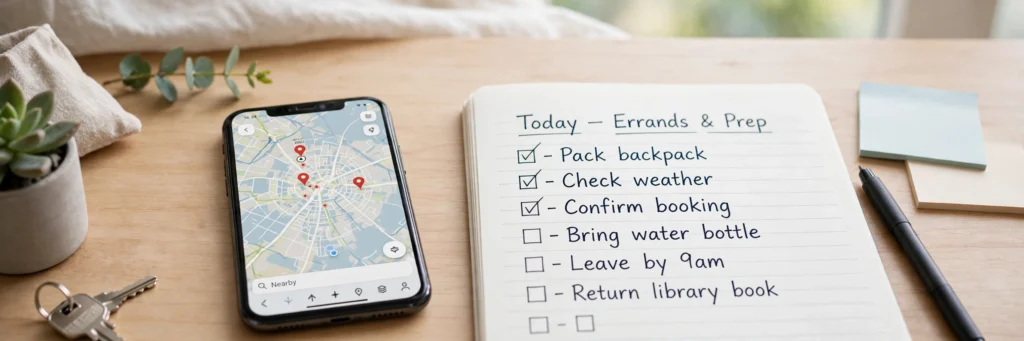
Two things happen when someone makes a local search. First, Google shows the map results (often called the Map Pack): three businesses with their ratings, hours and phone numbers, picked from Google Business Profiles. Second, it shows the normal website results underneath, favouring pages that are clearly relevant to that place and that search.
That means local SEO has two homes: your Google Business Profile, which drives the map results, and your website, which supports them. For most small businesses, the profile does the heavier lifting — many customers call straight from the map without ever visiting a website.
The three things Google weighs up
Google explains its local ranking in terms of three factors. Understanding them makes every piece of local SEO advice make sense.
Relevance — how well your business matches the search. If your profile’s category is wrong or your services list is empty, Google cannot connect you to the right searches, however good your work is.
Distance — how far your business is from the person searching. You cannot change your location, and you cannot rank across a whole city from one postcode. This is the one factor mostly out of your hands, which is why the other two matter so much.
Prominence — how well-known and trusted your business looks. Reviews, ratings, links from other sites, mentions of your business around the web, and an active, complete profile all feed this. It is Google asking: do real people seem to choose and talk about this business?
What local SEO involves, in practice
Stripped of jargon, the work is mostly housekeeping done well and done consistently:
- Claim and complete your Google Business Profile. Right category, full services list, accurate hours, real photos, correct phone number and website link.
- Keep your details consistent. Your name, address and phone number should read identically on your website, your profile and directory listings.
- Earn and answer reviews. A steady flow of genuine reviews, each with a reply, is one of the clearest trust signals a small business can build.
- Make your website locally clear. Mention the areas you serve, describe each service on its own page, and make sure the site works well on a phone — most local searches happen on one.
- Add fresh signs of life. New photos, updated holiday hours, the odd post on your profile. An active profile looks like an open business.
Notice what is not on that list: tricks. Lasting local SEO is unglamorous — accuracy, completeness and consistency, maintained over time.
How long does it take to show results?
There is no fixed timetable, and anyone who gives you one is guessing. Fixing a wrong category or a broken website link can change what you appear for fairly quickly. Building prominence — reviews, mentions, a profile that clearly stays active — takes months of steady work, because Google is watching for a pattern, not a single busy weekend. Judge your progress monthly: Are you appearing for more searches? Are calls and direction requests trending up in your profile’s insights? Those quiet numbers tell you more than checking your position every morning.
What local SEO is not
It is not a one-time setup. A profile built once and abandoned slowly rots: hours go wrong, services change, reviews go unanswered. It is not a guarantee, either. Nobody honest can promise you the top map spot, because distance and your competitors’ efforts are real factors. And it is not only for big firms — the map results are one of the few places a small local business competes on roughly equal terms with chains, because Google is matching nearby customers to nearby businesses, not to the biggest marketing budget.
It is also not fully automatic. Tools can organise the routine — reminding you about reviews, keeping posts and details in one place — but the photos should be your real work, the replies should sound like you, and anything written with AI help still needs a human read-through before it represents your business.
Where to start this week
If you do nothing else, do these three things. First, search your main service and town on your phone and see where — or whether — you appear. Second, open your Google Business Profile and complete anything blank, starting with category and services. Third, ask your next three happy customers for a review, and reply to the ones already sitting there.
That is the honest core of what local SEO is: being accurately findable, visibly trusted, and clearly active in the place you actually serve.

Questions owners ask next
Do I need local SEO if I already have a website?
Yes, because the two do different jobs. Your website competes in the normal results underneath, but the map results — where many customers call from directly, without ever visiting a site — are built from Google Business Profiles. Local SEO has two homes, the profile and the website, and for most small businesses the profile does the heavier lifting.
Can I do local SEO myself, or do I need an agency?
You can do the core of it yourself, because the work is mostly housekeeping done well and consistently: complete your profile, keep your details identical everywhere, earn and answer reviews, and make your website clear about what you do and where. Tools can organise the routine, and help is available if time is the problem — but no tool or agency changes what the work actually is.
How much does local SEO cost?
The fundamentals cost nothing but time. Claiming and completing your profile, asking for reviews, replying to them, adding photos and fixing inconsistent listings are all free — they ask for consistency, not budget. Paid help and software are optional extras for organisation; the signals Google weighs most, relevance, distance and prominence, are built by the free work.
How do I know if my local SEO is working?
Judge it monthly, not daily. Look inside your profile’s insights: are you appearing for more searches, and are calls and direction requests trending up over time? Those quiet numbers tell you more than checking your position every morning. Fixing a wrong category can change things fairly quickly; building prominence takes months of steady pattern, and that is normal.
What to do next
Work through the three starting steps above, then set a short monthly routine so the profile never goes stale. If you would like that routine organised in one place, the system I use is described on my Local Alchemist AI page.
Disclosure: the page linked above contains an affiliate link. If you buy through it, I may earn a commission at no extra cost to you.