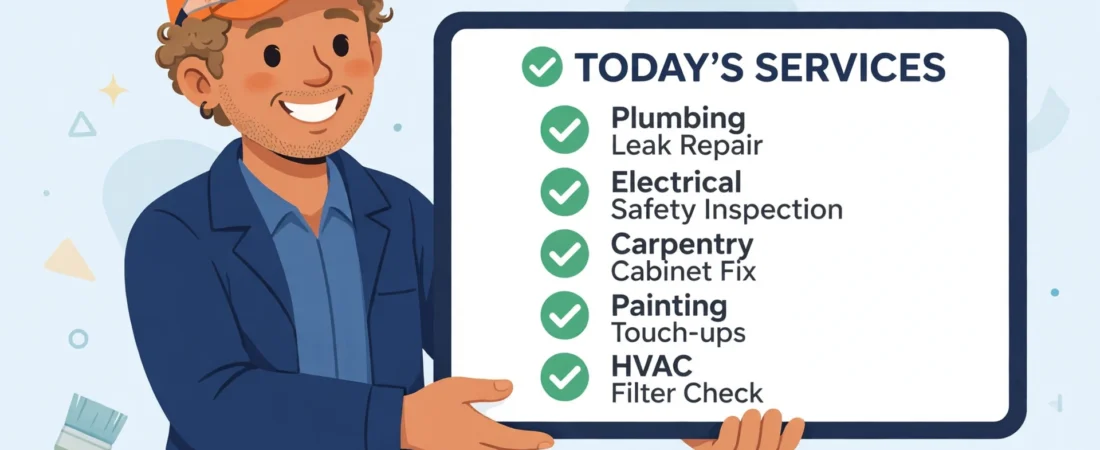
Your services list is the most underused part of your whole profile. Most businesses either leave it empty or accept the few default lines Google suggests — and then wonder why they show up for their business name but never for the jobs customers actually search. A well-built Google Business Profile services list tells Google, in plain words, every job you want to be found for.
Think of each service as a small doorway. Every accurate, clearly described service is one more search you can legitimately appear in. Here is how to build the list properly.
The short answer
Build your Google Business Profile services list from the jobs you actually do: accept Google’s suggested services that genuinely apply, add custom entries for real work the suggestions miss, and write each description plainly — what the job involves, who it is for, what is included — in the words customers search with.
Why the services list matters more than it looks
When a customer searches something specific — “boiler service,” “balayage,” “emergency locksmith” — Google looks for profiles that name that service. Your primary category covers what your business is; your services list covers the individual things you do. Profiles with complete, specific service lists match more of these detailed searches than profiles that leave Google guessing from a category alone.
The list also helps the customer. Someone comparing two businesses will choose the one that clearly offers the exact job they need, at a glance, without having to phone and ask.
Start with Google’s suggested services, then add your own
When you edit your services, Google suggests entries based on your category. Accept every suggestion that genuinely applies — these are written in Google’s own vocabulary, which is the vocabulary customers search with. Then add custom services for the real jobs the suggestions miss: the specialist repair, the seasonal service, the package your regulars know you for.
Work through your last few months of actual work. Every job you were paid to do more than once probably deserves a line. Every job you would happily take again definitely does.
How to write a service description that actually helps
Each service can carry a short description. Keep it plain, specific, and written for a nervous customer, not for an algorithm:
- Say what the job involves in one or two short sentences.
- Say who it is for — homes, landlords, salons, offices — if that is genuinely your market.
- Mention what is included where it matters: parts, a guarantee, a fixed call-out, a tidy-up afterwards.
- Use the words customers use, not trade jargon they have never heard.
Avoid stuffing every description with your town name and keywords repeated in slightly different orders. It reads badly, it does not help, and customers can smell it. One honest, clear description per service beats five lines of word salad.
Should you add prices?
You can attach a price or a price range to a service. If your pricing is genuinely fixed — a standard service, a set menu treatment, a published call-out fee — showing it builds trust and filters out enquiries that were never going to fit your prices. If every job is quoted after inspection, leave the price off and say in the description that you quote after a quick look. A blank price is fine; a misleading price is not.
Remove what you no longer offer
An out-of-date list quietly costs you twice: it can surface you for jobs you will turn down — wasting the customer’s time and your answer rate — and it makes the whole profile look neglected. When you retire a service, drop a team member’s specialism, or stop covering a type of job, take ten minutes to remove it. Accuracy is a ranking signal and a courtesy at the same time.
A simple monthly routine to keep it current
Services drift out of date because updating them feels like a big job. Make it small: once a month, when you check your profile, scan the list and ask three questions. What did we start offering? What did we stop? What did customers ask for that is not written here? Five minutes keeps the list honest all year — and tools can draft the wording, but a human should always read it before it goes live, because only you know what you actually offer. Seasonal services deserve the same treatment: add the winter boiler service or the summer garden tidy when the season approaches, and retire it when the season ends, so the list always mirrors the work you would actually accept this month.
How many services should you list?
There is no prize for the longest list. A focused list of eight to fifteen accurate services will beat a sprawling list of forty vague ones, because every line should be a job you genuinely want, can actually deliver, and would be happy to be judged on. If two entries describe nearly the same job, merge them into the clearer one. If a service needs three attempts to explain, split it or simplify the wording. Read the finished list as a customer would: within thirty seconds, they should know exactly what you do, and the one thing they need should be easy to spot.
Questions owners ask next
How many services should I list?
Aim for a focused list of roughly eight to fifteen accurate services. That beats a sprawling list of forty vague ones, because every line should be a job you genuinely want, can actually deliver, and would be happy to be judged on. If two entries describe nearly the same job, merge them into the clearer one; read the finished list as a customer would.
Should I repeat my town name and keywords in every description?
No. Stuffing descriptions with your town name and the same keywords in slightly different orders reads badly, does not help you rank, and customers can smell it. One honest, clear description per service — what the job involves, who it is for, what is included — beats five lines of word salad every time.
Do services matter if my primary category is wrong?
They do different jobs, and you need both right. Your primary category covers what your business is; the services list covers the individual things you do, and it is what matches you to specific searches like “boiler service” or “emergency locksmith”. Fix the category first if it is wrong, then build the list — a strong list on the wrong category is a doorway in the wrong street.
How often should I update my services list?
Monthly, in five minutes, alongside your other profile checks. Ask three questions: what did we start offering, what did we stop, and what did customers ask for that is not written here? Give seasonal services the same treatment — add the winter boiler service as the season approaches, retire it when the season ends — so the list always mirrors work you would accept this month.
What to do next
Open your services list today and count how many of your real, paid services are missing. Add them with plain descriptions, remove what you no longer do, and re-check monthly. If you run this routine for clients and want it organised in one place, you can see the system I use on my Local Alchemist AI page.
Disclosure: the page linked above contains an affiliate link. If you buy through it, I may earn a commission at no extra cost to you.