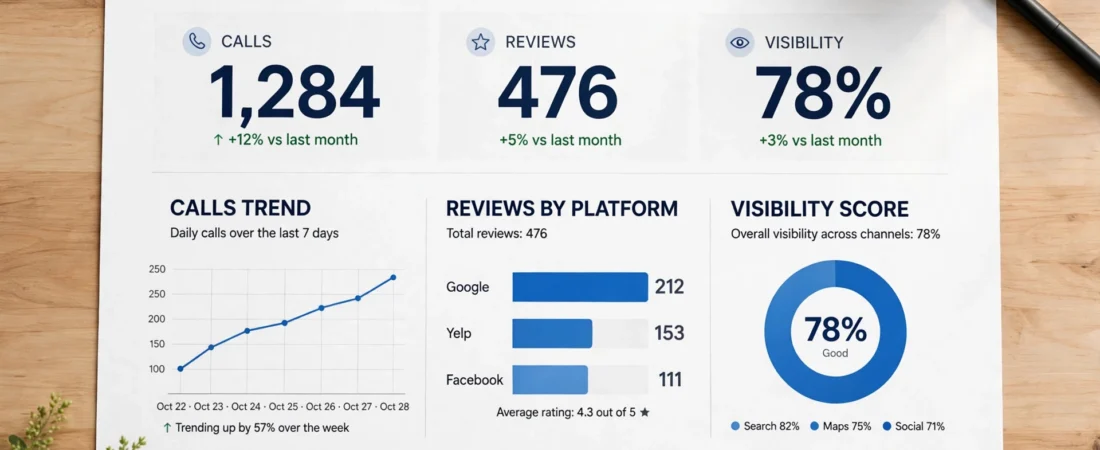
Most monthly reports fail in the same way: ten pages of charts the client never opens. A local marketing report for clients works when it fits on one page, uses numbers the owner cares about, and can be read in under two minutes. This is the format I recommend to freelancers and small agencies who manage Google Business Profiles for local businesses.
The short answer
A local marketing report clients actually read fits on one page with five blocks: a visibility snapshot versus last month, the actions customers took — calls first — reviews new, average and replied, the work completed, and next month’s plan in three lines. Read in under two minutes, it answers: are more people finding us, and calling?

Why one page beats ten
Your client runs a business, not a marketing department. They want to know three things: Are more people finding us? Are more people calling? What did you do, and what happens next? Everything on the page should answer one of those questions. If a metric does not, it does not belong — no matter how impressive the graph looks.
Block 1: Visibility snapshot
Start with how many people saw the profile this month compared with last month, and the main searches that surfaced it. Use the figures from Google Business Profile performance data, shown honestly as they are. A simple “up from last month / down from last month” arrow beside each number tells the story faster than any chart.
Block 2: Actions customers took
Under visibility, list what those viewers did: calls, direction requests, website clicks, and messages. Calls deserve the biggest type on the page — they are the number the owner feels in the till. Again, compare with last month and keep the wording plain: “24 calls came through the profile in June, up from 19 in May.”
Block 3: Reviews — new, average, and replied
Show how many new reviews arrived, the current average rating, and confirmation that every review was replied to. Quote one short line from a happy review if the client is comfortable with it. Reviews are the section owners read most closely, because they are about their reputation, not your marketing.
Block 4: Work completed this month
A short bullet list of what you actually did: profile fields corrected, photos added, posts published, questions answered, details updated. This is your proof of work, and it matters at renewal time. Keep each bullet to one line and use the owner’s language, not jargon — “added photos of the new showroom,” not “optimised visual assets.”
Block 5: Next month — three lines maximum
End with the plan: the two or three things you will do next month and anything you need from the client, such as new photos or holiday opening hours. A clear next step makes the report feel like a partnership instead of an invoice attachment.
A worked example, in words
Imagine a one-page report for a plumber. Top line: 1,240 people saw the profile in June, up from 980 in May. Actions: 31 calls, 58 direction requests. Reviews: 6 new, average now 4.8, all replied to. Work done: fixed the primary category, added emergency call-out to the services, published four posts, added nine photos of finished jobs. Next month: add the new service area, request reviews after every completed job, update hours for the bank holiday. That is the entire report — and the owner can see the value of the service in about forty seconds.
Mistakes that make clients stop reading
Three habits kill reports. The first is screenshots of raw analytics dashboards, which mean nothing to a non-marketer. The second is invented or estimated numbers — if a figure cannot be traced to the client’s own profile data, leave it out; one discovered exaggeration destroys the trust the report exists to build. The third is reporting activity without outcomes: “we posted four times” belongs in the work block, but the client renews because of the calls and reviews at the top of the page, so lead with those every time.
Keeping it to one page when a client asks for more
Sooner or later a client will ask for “more detail.” Give it gracefully without breaking the format: keep the one-page summary as the report itself, and attach extra detail — the full review list, the search terms, the photo log — as an appendix they can open if they wish. The summary stays readable, the thorough client feels served, and you are never tempted to pad the main page. If a number matters enough to discuss, it belongs on the page; if it is there for completeness, it belongs in the appendix. That one rule keeps the report honest about what actually deserves the client’s attention each month, and it protects the habit that makes the whole system work: a busy owner who knows the report takes one minute to read will keep reading it, month after month, and keep connecting it with the fee they pay you.
The local marketing report for clients: sending rhythm
Send the report on the same day each month, in the same format, with one short message pointing at the single most important number. Consistency is what turns a report into a retention tool: the client learns to expect it, skims it in a minute, and connects your fee to visible activity. Only report numbers you can stand behind — every figure should come straight from the client’s own profile data, never estimated or dressed up.

Questions owners ask next
What do I do in a month when the numbers went down?
Report them exactly as they are. Every figure on the page should come straight from the client’s own profile data, shown honestly — a simple “down from last month” beside the number, with the work block showing what you did about it. Never invent or estimate numbers to soften a quiet month: one discovered exaggeration destroys the trust the report exists to build.
My client keeps asking for more detail — should the report get longer?
No — keep the one-page summary as the report itself, and give the detail somewhere else. Attach the extras as an appendix the client can open if they wish: the full review list, the search terms, the photo log. The summary stays readable, the thorough client feels served, and the main page never gets padded. If a number matters enough to discuss, it belongs on the page; if it is there for completeness, it belongs in the appendix.
How often should I send it, and does the day matter?
Monthly, on the same day each month, in the same format, with one short message pointing at the single most important number. That consistency is what turns a report into a retention tool: the client learns to expect it, skims it in a minute, and connects your fee to visible activity. A report that arrives at random times, in changing formats, quietly stops being read.
Which number should be biggest on the page?
Calls. They are the number the owner feels in the till, and owners renew because of the calls and reviews at the top of the page — not because of activity lower down. Give calls the biggest type, compare them with last month in plain words (“24 calls came through the profile in June, up from 19 in May”), and let visibility and work done support that headline rather than compete with it.
What to do next
Build your own one-page template from the five blocks above and use it for every client, every month. If you would like the routine behind the report — the profile checks, review replies, and content that feed it — handled in one system, you can see what I use on my Local Alchemist AI page.
Disclosure: the page linked above contains an affiliate link. If you buy through it, I may earn a commission at no extra cost to you.