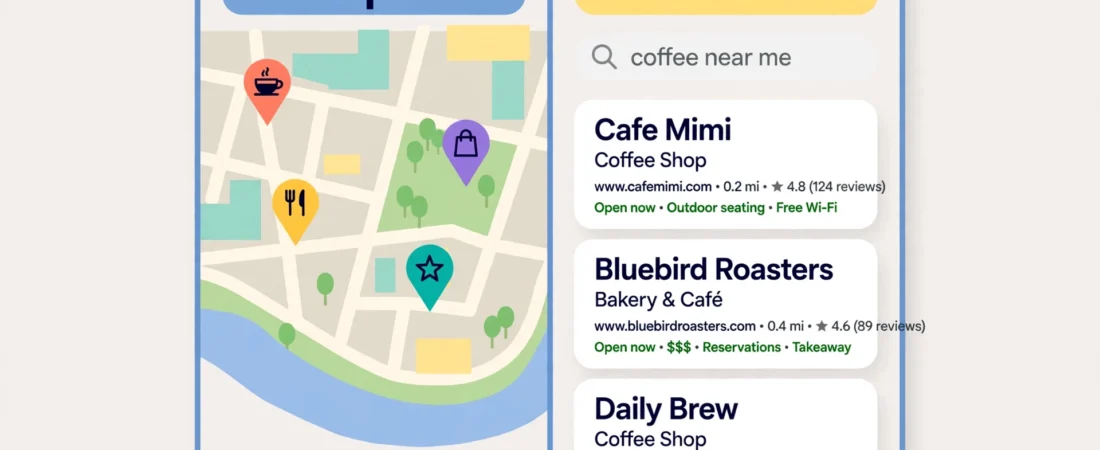
A small business owner gets two quotes. One freelancer offers “SEO”. Another offers “local SEO”. The prices differ, the promises sound similar, and the owner reasonably asks: are these the same thing with different labels? They are not — and confusing local SEO vs SEO is expensive, because a business can spend a year paying for the wrong one and see almost nothing change. This article puts the two side by side: where the results appear, what gets ranked, what the work actually involves, and how to decide which one your business needs. The confusion is understandable, because the two overlap at the edges — your website supports both — and because plenty of sellers blur them deliberately, since a blurred service is harder to judge.
For the full plain-English explanation of the local side alone, read what local SEO is afterwards. Here, the point is the comparison.
The short answer
Regular SEO ranks web pages in Google’s main results for searches answered from anywhere; local SEO ranks a business — mainly its Google Business Profile — in the map results for searches needing someone nearby. Same search engine, two different contests. Most businesses serving customers in a place need local SEO first.
The simplest way to see it
Regular SEO is about ranking web pages in Google’s main list of results, for searches that can be answered from anywhere. Local SEO is about ranking a business — mostly its Google Business Profile — in the map results, for searches where the customer needs someone nearby.
Same search engine, two different contests, two different scoreboards. Any provider you hire should be able to explain both scoreboards this plainly before a contract is signed — and to track the numbers for each separately, in one simple report rather than blended into a single vague “traffic” figure.
| Regular SEO | Local SEO | |
|---|---|---|
| What gets ranked | Pages on your website | Your Google Business Profile (and your site, secondarily) |
| Where it appears | The main list of blue-link results | The map and the local pack of three businesses |
| Typical search | “how to fix a leaking tap”, “best accounting software” | “plumber near me”, “accountant in Leeds” |
| Main signals | Content quality, links from other sites, site structure | Category, reviews, profile completeness, proximity, consistency of business details |
| Who needs it most | Businesses selling online or nationally | Businesses serving customers in a place |

A worked example: one bakery, two searches
Take a fictional bakery that sells celebration cakes locally and also posts recipes online. Watch what happens with two different searches.
Search 1: “wedding cake delivery”. Google returns articles, big retailers and recipe sites from the whole country. The winners are strong web pages with good content and links. This is regular SEO territory. If the bakery wants in, it needs a genuinely useful page about wedding cake delivery that out-competes national content — hard, slow, and possibly worth it if they truly deliver widely.
Search 2: “bakery near me”. Google ignores the recipe pages entirely. It returns the map and three nearby bakeries, ranked by how close they are, whether their profiles are complete, and what their reviews say. The bakery’s beautiful blog post does nothing here. A complete profile with 200 reviews and accurate hours does everything.
The bakery needs both kinds of visibility only if it genuinely sells both ways. Most local businesses live or die by Search 2 — and it is the one that costs less and moves faster.
What the work looks like on each side
Regular SEO work is website work: researching the words customers type (the method in how to do local keyword research for free covers the local side of that skill), writing and improving pages, fixing technical problems, and earning links from other websites. Results typically build over months, and competition is national or global.
Local SEO work is profile and reputation work: claiming and completing the Google Business Profile, choosing the right category, listing services properly, keeping name/address/phone consistent everywhere, gathering and answering reviews steadily, adding real photos, and keeping hours accurate. Much of it is free, all of it is unglamorous, and for a local business it usually produces enquiries sooner than any website project. There is also a measurement difference worth knowing: regular SEO success shows up as page rankings and website visits, while local SEO success shows up as calls, direction requests and profile views — a business judging local work by website traffic alone will wrongly conclude that it failed. The overlap between the two is real but partial: a good website supports local rankings, and local work does nothing for your national content.
Which one does your business need?
Ask one question: where does the customer stand when they need you?
- If the answer is “in my town, today, with a problem” — a burst pipe, a locked door, a toothache, a hunger — you need local SEO first. That is most trades, clinics, salons, cafés, shops and local services.
- If the answer is “anywhere, comparing options online” — you sell nationally, ship products, or publish content for a wide audience — regular SEO leads.
- If both are true, sequence them: local first for most small businesses, because it is cheaper, faster to show results, and funds the slower regular-SEO build later. A stretched budget split evenly across both usually means neither gets done properly; the local SEO on a budget guide shows how far the local side can go with almost no spend. Businesses that hire the local side out often keep the profile work — reviews, posts, monthly visibility numbers — run through one local marketing system while the website content is handled as its own separate project.
One warning about buying either: an agency that cannot tell you which of the two it is selling you, and which searches it is targeting, is selling fog. Ask every provider the bakery question — “show me the two kinds of results and which one you’re putting me in” — and watch whether the answer is clear.

Questions owners ask next
Can I judge my local SEO by my website traffic?
No — that is the most common measurement mistake. Regular SEO success shows up as page rankings and website visits; local SEO success shows up as calls, direction requests and profile views, because many customers act straight from the profile without ever visiting a site. A business judging local work by website traffic alone will wrongly conclude that it failed.
Do I need both kinds of SEO?
Only if you genuinely sell both ways. If customers stand in your town, today, with a problem, local SEO comes first — it is cheaper, faster to show results, and funds the slower regular-SEO build later. If you sell nationally or publish for a wide audience, regular SEO leads. A stretched budget split evenly across both usually means neither gets done properly.
How can I tell if a provider is selling me the wrong one?
Ask every provider the bakery question: “Show me the two kinds of results and which one you’re putting me in.” A competent provider explains both scoreboards plainly before any contract — pages in the main list on one side, the profile in the map pack on the other — and tracks the numbers for each separately. An agency that cannot tell you which of the two it is selling, and which searches it is targeting, is selling fog.
Does a good website help my local rankings anyway?
Partly — the two overlap at the edges. A good website supports local rankings, and your profile work does nothing for your national content. But for most local searches the profile does the heavier lifting: the map results are built from Google Business Profiles, and the website is visited afterwards, if at all, to confirm a decision already made.
What to do next
Run the test on your own business this week: search your trade plus “near me” from your phone, and separately search your main service with no location. Look at which results Google shows in each case, and where you appear — that pair of searches tells you which contest you are actually in. If the local one is where your customers are, start with the profile fundamentals and add the website work second. And if you run this work for clients and want the profile, reviews and reporting side organised in one system, you can see the setup on my Local Alchemist AI page.
Disclosure: the page linked above contains an affiliate link. If you buy through it, I may earn a commission at no extra cost to you.