
Local SEO in London plays by the same rules as everywhere else — and is somehow a completely different contest. The difference is density. In a market town, “near me” might mean three competitors within two miles. In London it can mean forty businesses in the same category within a fifteen-minute walk, all chasing the same search. It is also the most expensive local market in the country to get wrong, because the businesses competing with you are numerous, close, and — in the best categories — professionally run. Generic UK advice — get listed, get reviews, keep your details consistent — is necessary in London, but it is only the entry ticket. What actually separates the businesses that win London searches is how hyperlocal they are willing to be.
The UK-wide Maps fundamentals still apply, and if your profile is not yet sound, start with how UK small businesses can rank higher on Google Maps. This article assumes that base and covers the London layer on top of it.
The short answer
Local SEO in London is a borough-level contest: with dozens of competitors within walking distance, one profile ranks strongly only around its real neighbourhood. Win by depth, not spread — a complete profile, reviews arriving steadily and answered, content that names the streets and stations locals use, and details consistent across the listings Londoners check.
The borough is the market
Londoners do not search “in London”. They search in neighbourhoods: “coffee shop clapham”, “physio near london bridge”, “hairdresser stokey”. Google knows this — its local results are built around proximity measured in streets, not in a Greater London sprawl. Practical consequences follow:
- Your profile’s physical location is your centre of gravity. A business ranks most strongly within a modest radius of its actual premises. No content trickery changes that, so choose profile details that speak to your real neighbourhood: services and posts that name it, photos that show it.
- Competing across London from one profile is mostly fiction. A single-location business trying to “cover London” with one profile and a stack of borough pages usually wins nowhere. Depth in one neighbourhood beats a thin presence in twelve.
- Neighbourhood naming matters. Use the names residents use — the village, the high street, the station area — in your services, posts and website copy, where they are genuinely true. Agencies running profiles for clients in several different boroughs keep each client’s neighbourhood routine — reviews, posts, photos — scheduled separately in one shared system, so a Clapham client’s post never lands on a Camden profile.
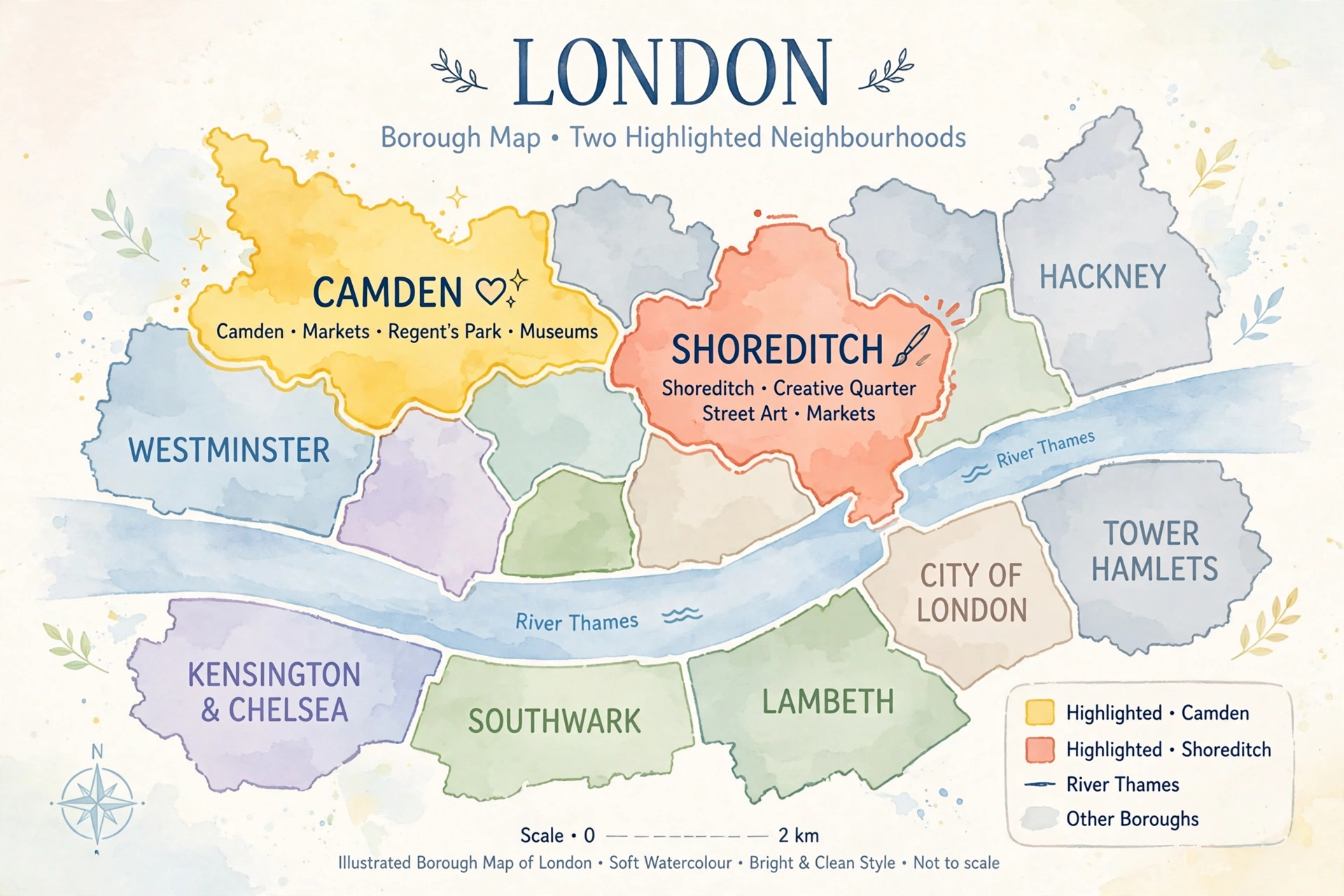
A worked example: one café, two boroughs
Here is an illustrative example of the strategy done properly. A café sits near the border of two South London boroughs — close enough that its customers genuinely come from both.
- One strong profile. The café keeps a single Google Business Profile at its real address, fully completed: correct category, full menu-linked services, hours including weekend brunch times, and fresh photos monthly.
- Reviews by neighbourhood, earned honestly. Staff ask every table the same way; over time, reviews naturally mention the area (“best brunch in…”), because the customers are locals. Nobody scripts or incentivises them — that breaches policy and London customers smell it instantly.
- One genuine location page. Its website carries one well-written page about the café in its neighbourhood — the street, the story, the local suppliers, directions from the station — instead of ten borough pages with the name swapped. The page is worth reading if you live there, which is precisely the test.
- Local listings that match. Its details are consistent across the directories Londoners actually use, kept in line with the approach in local citations: where to list your business — the same name, address and phone everywhere, no variations.
The café does not rank across London. It ranks powerfully within walking distance — which, in London, is where nearly all of its money comes from. That is the realistic shape of winning in the capital.
Competition changes the review maths
In a small town, fifteen reviews might put you ahead. In a competitive London category, the leading profiles often carry several hundred, arriving steadily. The lesson is not “get hundreds fast” — any shortcut there breaches Google’s rules and risks the profile itself — but that recency and steadiness matter more in London: a profile whose last review is four months old reads as half-closed next to competitors reviewed this week. There is a second London effect working against you as well: churn. London customers have endless alternatives, so one neglected month — unanswered reviews, wrong holiday hours, a profile that looks asleep — quietly loses regulars to the place two streets away that looked alive. In a quiet market a neglected profile coasts for a while; in London it sinks, which is why the maintenance rhythm matters more here than the launch ever did. Build the ask into daily operations (till prompt, receipt, a QR card by the door) and answer every review; in dense categories the reply thread is part of your shopfront. The foundations of local search that underpin all of this are in what local SEO is for owners who want the full picture.
What to stop doing in London
- Making a page per borough. Twenty swapped-name pages is the doorway pattern; in London it is also instantly recognisable to customers. One genuine page per real location, nothing more.
- Adding fake locations. A “virtual office” address in a second borough to rank there breaches Google’s rules and risks suspension of the real profile too. The risk-reward is terrible.
- Stuffing the business name. “Best Cheap Plumber London 24/7” as a profile name is a policy breach and a suspension risk, not a strategy.
- Chasing city-wide keywords on a single-site business. Spend that effort within your radius, where searches convert.
- Ignoring the profile after a good month. London rankings are rented, not owned; the competitor who keeps collecting reviews and posting photos will pass a static profile within a quarter.
London freelancers and agencies running this work for multiple clients usually find the borough-by-borough routines — reviews, posts, listings, checks — stay manageable when they are organised in one client system rather than in separate notebooks per client.

Questions owners ask next
Can one profile rank across the whole of London?
Mostly, no — that is fiction. A business ranks most strongly within a modest radius of its actual premises, and no content trickery changes that. A single-location business trying to “cover London” with one profile and a stack of borough pages usually wins nowhere. Depth in one neighbourhood beats a thin presence in twelve, because in London nearly all of a local business’s money comes from within walking distance anyway.
Competitors have several hundred reviews. How do I catch up without shortcuts?
Slowly, and by rhythm rather than volume spikes. Any shortcut there breaches Google’s rules and risks the profile itself. What matters more in a dense market is recency and steadiness: build the ask into daily operations — till prompt, receipt, a QR card by the door — and answer every review. A profile whose last review is four months old reads as half-closed next to competitors reviewed this week.
Can I add a virtual office in another borough to rank there?
No. A “virtual office” address in a second borough breaches Google’s rules and risks suspension of your real profile too — the risk-reward is terrible. The same applies to borrowed addresses and keyword-stuffed names like “Best Cheap Plumber London 24/7”: a policy breach and a suspension risk, not a strategy. One genuine page per real location, nothing more.
My profile had a good month, then slipped. Why?
Because London rankings are rented, not owned. Churn is the second London effect: customers have endless alternatives, and one neglected month — unanswered reviews, wrong holiday hours, a profile that looks asleep — quietly loses regulars to the place two streets away that looked alive. The competitor who keeps collecting reviews and posting photos will pass a static profile within a quarter. Maintenance matters more here than the launch ever did.
What to do next
Search your category plus your neighbourhood from your phone this week and look honestly at the top three profiles: their review counts, their recency, how local their content feels. Then pick the one gap you can close first — usually the review routine or a profile full of last year’s details — and close it. London rewards the business that is most convincingly of its neighbourhood. If you want the whole routine organised — profile, reviews, posts and reporting for your business or your clients — you can see the setup on my Local Alchemist AI page.
Disclosure: the page linked above contains an affiliate link. If you buy through it, I may earn a commission at no extra cost to you.