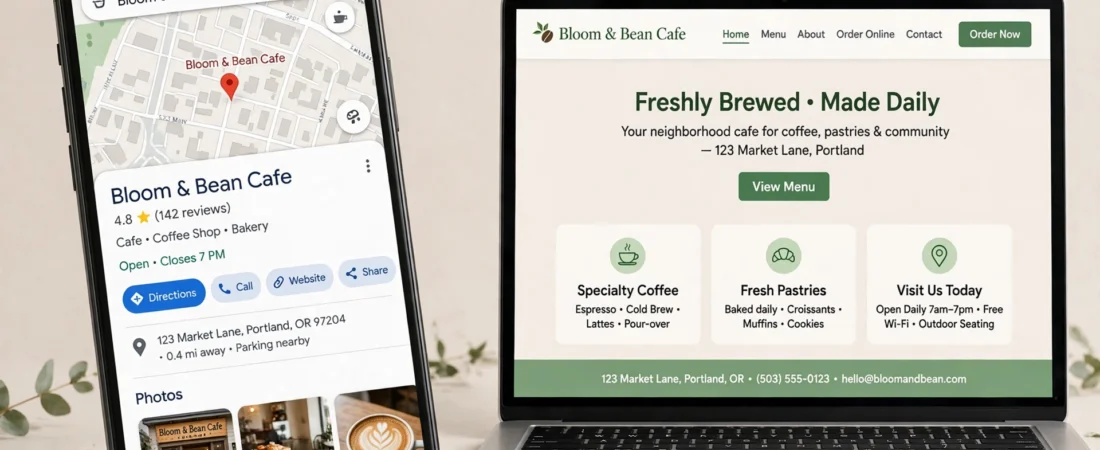
“Google Business Profile vs website — which one actually brings me customers?” It is a question local business owners ask a lot, usually when deciding where to spend limited time and money. The honest answer is that they do different jobs. Your profile usually wins the first contact; your website usually finishes it. Most local businesses need both, in that order.
The short answer
A Google Business Profile and a website do different jobs: the profile usually wins the first contact — it is what shows in map results with your rating, reviews, photos and call button — while the website finishes it with detail, trust and booking. Most local businesses need both, profile first, because that is where discovery happens.
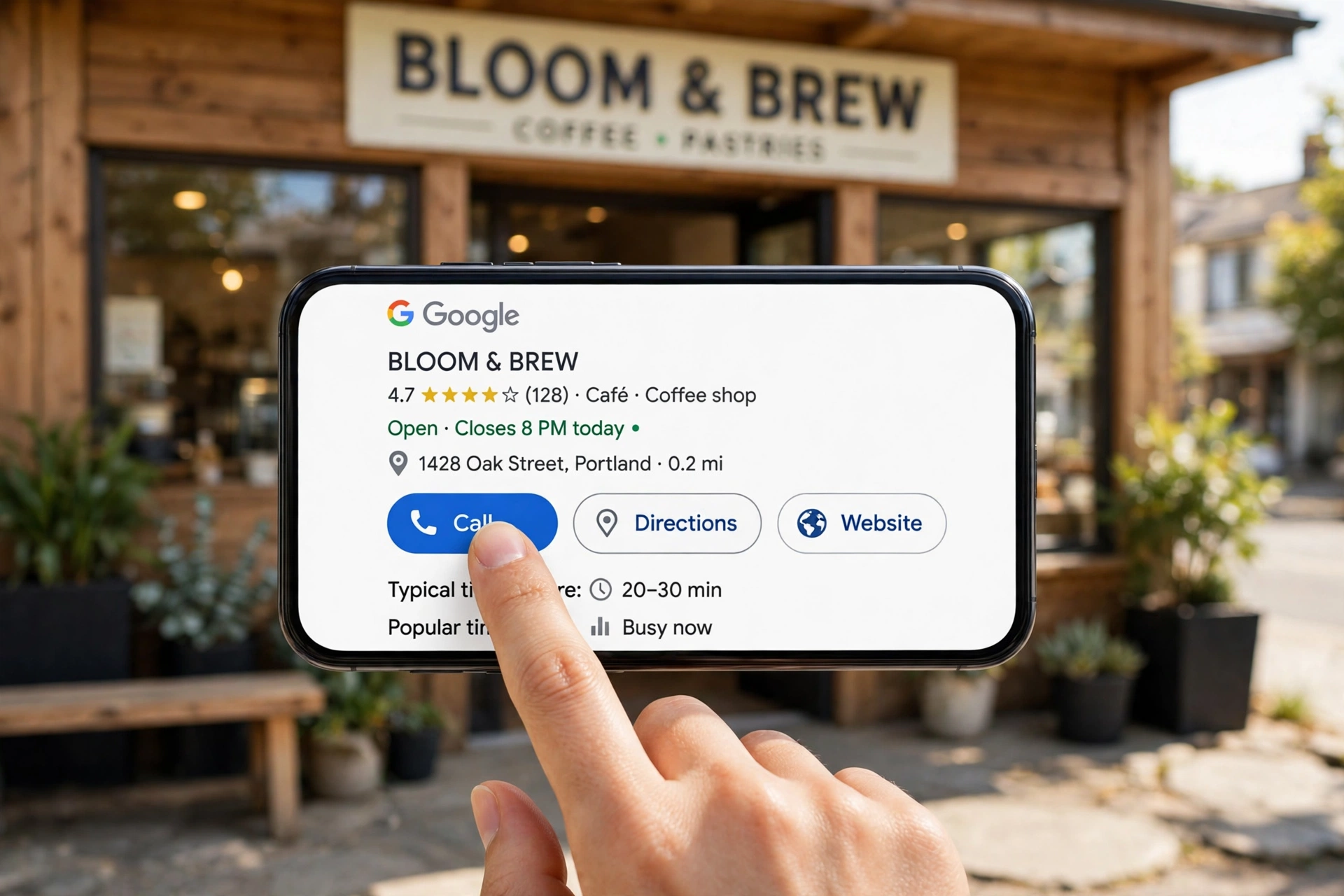
The profile’s job: being found and chosen in the moment
When someone searches “emergency plumber near me” or “café open now,” they are looking at the map results — and those results are Google Business Profiles, not websites. The profile is what shows your rating, your reviews, your photos, whether you are open, and the call button the customer taps without ever visiting a website. For the huge share of local searches that end right there, the profile is not one option among many. It is the whole contest.
The website’s job: trust, detail and control
The customers who do click through are checking you out: full services, prices or price guides, your story, booking forms, galleries of your work. A website carries the detail a profile cannot. It is also the one asset you actually own. Your profile lives on Google’s platform, under Google’s rules — it can be changed, suspended, or redesigned without your permission. Your website and its content are yours.
What happens with only a profile
A strong profile with no website can work for a while, especially for trades where the phone call is everything. But you lose the click-through customers who wanted more detail before calling, you have nowhere to send people from social media or adverts, and a profile problem — a suspension, a wrong edit by a stranger — can make you invisible overnight with no fallback. It is a good shop window with no shop behind it.
What happens with only a website
The mirror image is more common and more costly: a lovely website and a neglected profile. Your website can rank in ordinary search results, but the map results sit above it on a phone screen, filled with competitors whose profiles are complete. Customers compare ratings and tap call buttons before your homepage ever loads. A website alone is a good shop on a street nobody walks down.
The honest costs of each
The profile is free in money but not in attention: it needs reviews encouraged, photos added, and details kept current, or it slowly decays. A basic website costs a modest amount to host and maintain, and it needs the same discipline with its details. The real waste is paying for either one and then neglecting it — an abandoned profile with two-year-old reviews, or a website whose contact page still shows an old phone number, actively loses you customers who checked and moved on. Budget a small, regular amount of time for both rather than a big spend on one and silence on the other.
A simple way to picture it
Think of the profile as your stall in a busy market: it is where passers-by see you, compare you with the stall next door, and decide in seconds. Your website is your shop behind the stall: the place serious buyers step into for the full range, the details, and the reassurance that you are established. A trader with only a stall can sell on a good day; a shop with no stall on market day waits for customers who may never wander in. Most local businesses do best with the stall well kept and the shop door open.
Google Business Profile vs website: the sensible order
If you can only fix one thing this month, fix the profile. It is free, it is where the first contact happens, and a complete profile with steady reviews will usually bring enquiries before website work does. Then make sure the website backs it up properly: correct contact details that match the profile exactly, clear service pages, and an easy way to call or book. Once both are sound, the routine is maintenance — reviews, photos, posts, and the occasional update on each.
How to tell which one is bringing your enquiries
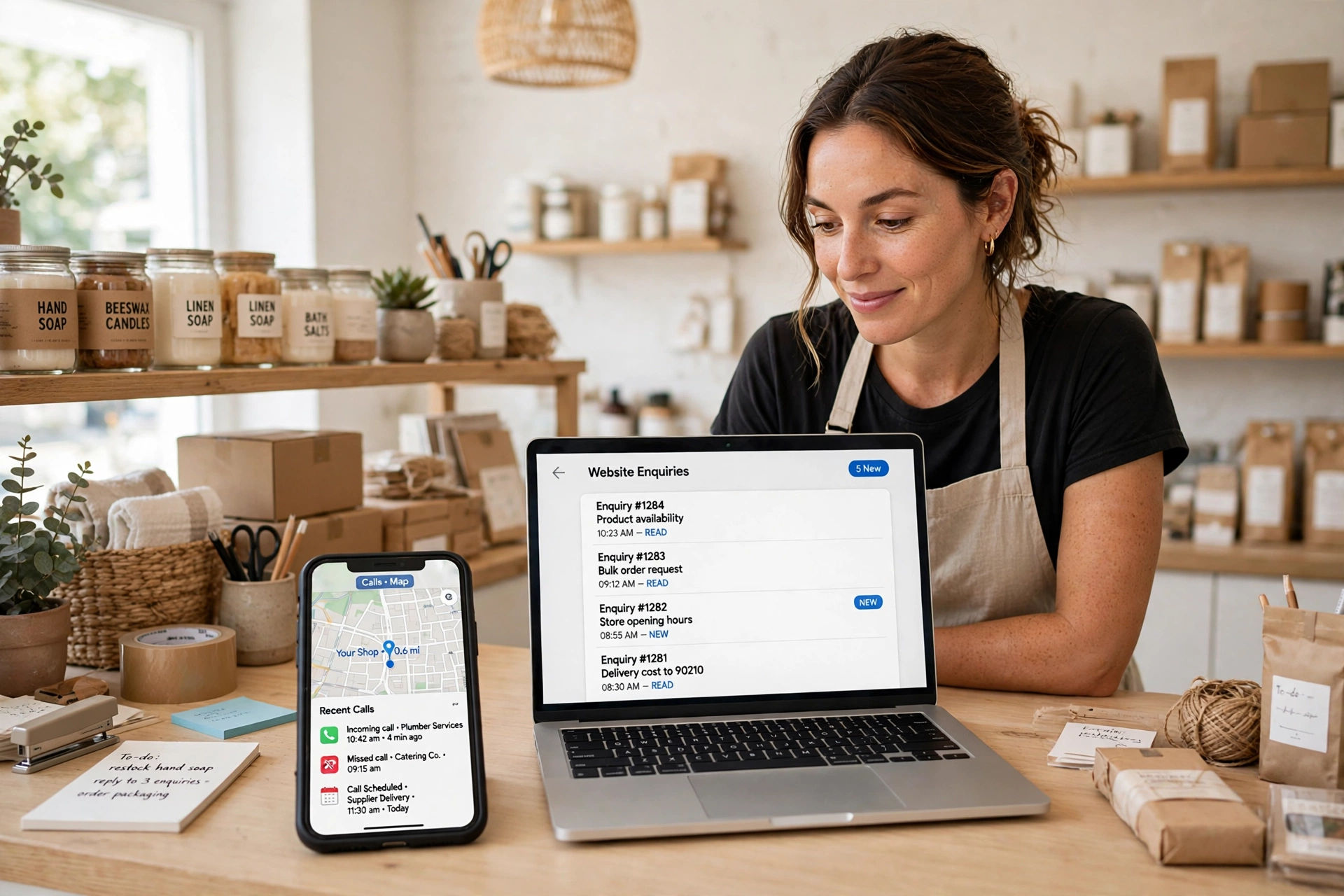
Ask new customers how they found you, and check the numbers each month: profile views, calls and direction requests on one side; website visits and enquiries on the other. Most owners are surprised by the split — the profile does the heavy lifting for discovery, while the website quietly converts the careful customers. Knowing your own split tells you where next month’s effort belongs. A simple habit helps: whenever you take a booking or a call, ask one question — “how did you hear about us?” — and jot the answer down. After a couple of months you will have better evidence about your own business than any general article, including this one, can give you, and you will know whether your next free hour belongs to the profile or the website.
Questions owners ask next
I can only fix one this month — which comes first?
The profile. It is free, it is where the first contact happens, and a complete profile with steady reviews will usually bring enquiries before website work does. Then make sure the website backs it up properly: contact details that match the profile exactly, clear service pages, and an easy way to call or book. Budget a small, regular amount of time for both after that, rather than a big spend on one and silence on the other.
My profile was suspended and I have no website — how bad is it?
That is the profile-only risk in its sharpest form. Your profile lives on Google’s platform, under Google’s rules, so a suspension — or even a wrong edit by a stranger — can make you invisible overnight, with nowhere to send people from social media or adverts and no fallback at all. A strong profile with no website is a good shop window with no shop behind it; the website is the asset you actually own.
My website is excellent but my profile is neglected — why are calls still low?
Because for most local searches, the contest happens above your website. The map results sit above the ordinary results on a phone screen, filled with competitors whose profiles are complete — ratings compared, call buttons tapped — before your homepage ever loads. A website alone is a good shop on a street nobody walks down. The profile is not one option among many for those searches; it is the whole contest.
How do I tell which one is actually bringing my enquiries?
Ask, and count. Whenever you take a booking or a call, ask one question — “how did you hear about us?” — and jot the answer down. Each month, compare the two sets of numbers: profile views, calls and direction requests on one side; website visits and enquiries on the other. Most owners are surprised by the split — the profile does the heavy lifting for discovery, the website quietly converts the careful customers — and knowing your own split tells you where next month’s effort belongs.
What to do next
Start with the profile, back it with a sound website, and keep both accurate. If keeping the profile routine — checks, reviews, posts and reporting — organised in one place would help, you can see the system I use on my Local Alchemist AI page.
Disclosure: the page linked above contains an affiliate link. If you buy through it, I may earn a commission at no extra cost to you.