
Most business owners know reviews matter. The hard part is knowing how to get more Google reviews without feeling like you are begging — or worse, making customers feel pressured. The good news: customers are usually happy to help. They just need to be asked at the right moment, in the right way, with the friction taken out.
This guide covers the timing, the wording, and the small systems that turn “we should ask for reviews” into a quiet, steady routine.
The short answer
The way to get more Google reviews without sounding pushy is to ask every customer once, at the moment they are happiest with the work, with a one-tap review link — and then stop. Thank them first, explain the review helps other local customers, and say there is no pressure. One gentle reminder is fine; a second becomes pressure.
Why most review requests fail
The typical request fails for three reasons. It comes too late — days after the job, when the good feeling has faded. It comes with no easy path — the customer has to search for your business and find the review button themselves. Or it sounds like a favour for you, instead of a chance for them to help the next customer.
Fix those three things and the reviews take care of themselves. Here is how to get more Google reviews in practice.
Ask at the moment of delight
Timing matters more than wording. The best moment is right after the customer has seen the result: the haircut is finished, the boiler is humming again, the car is fixed, the meal was lovely. That is when goodwill is highest and the experience is fresh.
Build the ask into the end of the job, not days later. For a tradesperson, that is the doorstep conversation. For a shop or salon, it is at the till. For online orders, it is the delivery or follow-up message sent the same day. If you wait a week, you are asking them to remember a feeling — and most will not get round to it.
Use a script that puts the customer first
You do not need to be a salesperson. A short, honest script works because it explains why the review helps and makes it sound easy — because it is. Two versions that work well:
In person: “Really glad you’re happy with it. If you have a minute later, a quick Google review genuinely helps people round here find us — and it helps me know we’re doing things right. No pressure at all if not.”
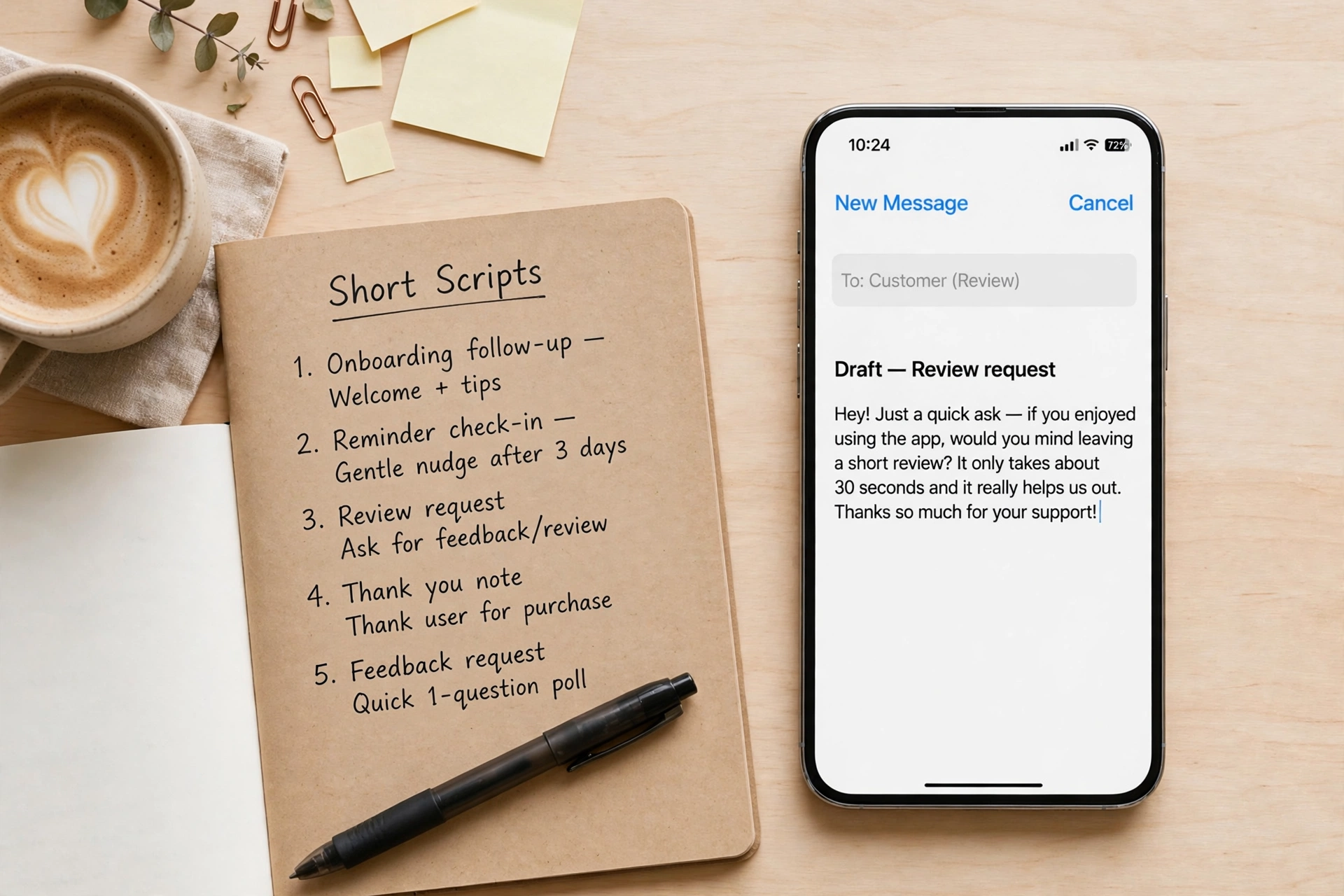
By text or email: “Hi [Name], thanks for choosing us today. If you were happy with the work, would you mind leaving a short Google review? It takes about a minute and it really helps other local customers find us. Here’s the link: [your review link]. Thanks either way.”
Notice what these scripts do: they thank first, explain the benefit to other customers, give a time estimate, and release the pressure at the end. That last part — “no pressure” — is what stops it sounding pushy.
Remove every bit of friction
Even a willing customer will abandon a review that takes effort. So make it one tap:
- Get your short review link. Google provides a direct link that opens your review box. Find it in your Google Business Profile dashboard and save it everywhere you need it.
- Print a QR code. Put it on receipts, invoices, business cards, the counter, and the van. Scanning beats typing.
- Use the link consistently. The same link should be in your text template, your email footer, and your follow-up messages.
One honest warning: never offer discounts, gifts or prizes in exchange for reviews, and never ask only happy customers while steering unhappy ones elsewhere. Both break Google’s rules, and reviews gained that way can be removed — or worse, the profile can be penalised. Ask everyone, the same way, and let the chips fall.
If they forget, one gentle reminder is fine
People are busy, and a forgotten review usually means a busy week, not a refusal. One polite reminder a few days later — “No worries if not, just resending the link in case it slipped by” — recovers a fair share of those reviews. Stop at one reminder. A second nudge turns a friendly request into pressure, and pressure is exactly what you are trying to avoid.
Reply to every review — it earns the next one
Replying is part of how to get more Google reviews, not a separate chore. Customers read replies before deciding whether to bother. A business that thanks people personally — and handles criticism calmly — looks worth recommending.
Keep replies short and specific. Thank the reviewer by name, mention one detail from their review so it does not read like a template, and invite them back. For negative reviews, acknowledge the problem, avoid arguing in public, and offer to sort it out directly. A graceful reply to a bad review often persuades more readers than the bad review puts off.
Turn it into a routine, not a campaign
Businesses that win at reviews do not run campaigns; they have a habit. The ask is in the checklist at the end of every job. The link is in every follow-up message. Replies happen once or twice a week, at a set time.
Pick one ask point, one script and one link, and use them for a month. Then look at the flow: a few new reviews a month, steadily, beats twenty in a panic followed by silence — for your ranking, and for how real it looks to anyone reading.

Questions owners ask next
How soon after the job should I ask for a review?
The same day, ideally within minutes of the customer seeing the finished result — that is when goodwill is highest and the experience is freshest. Build the ask into the end of the job itself: the doorstep conversation, the till, or a follow-up message sent that evening. Wait a week and you are asking them to remember a feeling, and most never get round to it.
Can I offer a discount or a freebie in exchange for a review?
No. Discounts, gifts and prizes offered for reviews break Google’s rules, and reviews gained that way can be removed — or the profile penalised. The honest version costs nothing: ask every customer, the same way, with no reward attached, and let the reviews be worth what they say because they were freely given.
How many reminders is it OK to send?
One. A single polite reminder a few days later — “just resending the link in case it slipped by” — recovers a fair share of forgotten reviews, because most non-responses are busy weeks, not refusals. A second nudge crosses the line from friendly to pushy, and pushy is exactly what makes customers quietly decide not to bother.
Should I ask unhappy customers for reviews too?
Yes — ask everyone the same way. Choosing only the customers you expect to be happy, and steering unhappy ones somewhere private instead, is called review gating and it is prohibited. Unhappy feedback is also genuinely useful: it shows you what to fix, and a calm, specific reply under a critical review often persuades future readers more than the criticism puts them off.
What to do next
Choose your moment of delight and write your one-sentence ask today. If you run this for clients as well as your own business, the asking, tracking and replying is easier with a routine behind it — the system I use for that is described on my Local Alchemist AI page. Before you set a target, check how many reviews you need to stand out.
Disclosure: the page linked above contains an affiliate link. If you buy through it, I may earn a commission at no extra cost to you.