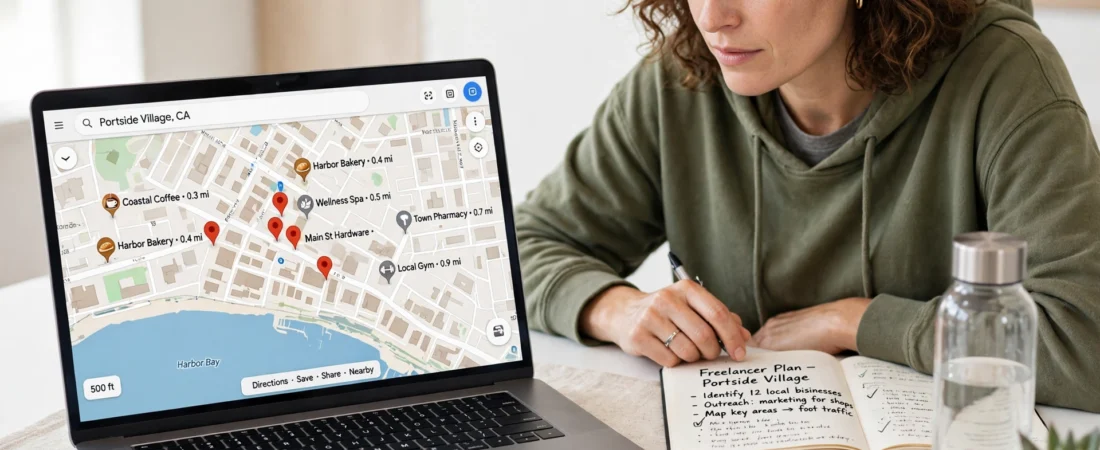
The hardest client is the first one. To get your first local SEO client without ads, you do not need a big audience or a fancy website. You need one local business with a visible problem, one honest conversation about it, and one small paid job done well. Here is the process, step by step.
The short answer
To get your first local SEO client without ads, pick one trade in one town, list its businesses from Google Maps, and audit each profile the way a customer sees it. Prepare a small one-page offer, then lead with one specific, true finding — not a pitch. One small paid job done well opens the monthly conversation.

Step 1: Pick one trade and one town
Do not offer “local SEO for everyone.” Choose one type of business you understand — plumbers, dentists, salons, cafés — in one town or city area you can visit. A tight focus makes your audit sharper and your conversation credible, because you can talk about that trade’s customers instead of marketing in general.
Step 2: Build a list from Google Maps
Search your chosen trade plus the town on Google Maps and open the top 20 results. Note each business’s name, rating, number of reviews, and whether its listing looks complete. You are looking for the gap: businesses doing good work whose profiles are weak. A business with decent reviews but a neglected profile is a better prospect than one with no presence at all.
Step 3: Audit each profile the way a customer sees it
For each prospect, check the same things a customer would notice: Is the primary category right? Are the services listed? Are there recent photos? Do they reply to reviews? Is the phone number correct and the website link working? Score each item simply — done, weak, or missing. This 10-minute check becomes the core of your offer. Do the audit on your phone as well as your laptop, because the map results your customers see are a phone experience, and problems like a missing call button or a wrong pin position are obvious there and invisible on a desktop.
Step 4: Prepare a one-page offer before you make contact
Before you approach anyone, write down your starter offer on a single page: the audit findings you will check, the fixes included in a clean-up, how long it takes, and the price. Having it written down changes how you sound in conversation — specific instead of vague. Decide in advance what the small first job includes and, just as importantly, what it does not, so a cheap starter job does not quietly grow into unpaid extras. You can refine the offer after the first client; it will never be perfect before you start, and it does not need to be.
Step 5: Lead with one useful finding, not a pitch
Contact the owner with one specific, true observation and one quick win. For example: “Your profile shows under your old business name, so customers searching the new name may not find you — the fix takes ten minutes.” That is helpful, not salesy. One finding opens the door; then you can offer the full audit and the fix list.
How to get your first local SEO client: the first conversation
Keep the first offer small and concrete: a one-off profile clean-up, or a paid audit credited against the work. Small offers are easy to say yes to, prove your competence, and naturally lead to the monthly conversation later. Be honest about what you will do, how long it will take, and what it will not do — you cannot guarantee rankings, and saying so builds trust with sensible owners.
Bring your audit sheet. Owners respond to seeing their own business scored against simple checks far better than to a lecture about algorithms.
Step 6: Deliver visibly, then ask for the next step
Do the job properly and show the before-and-after: screenshots of the old profile beside the fixed one, the review link set up, the first posts published. Then ask two questions: would they like you to keep it updated monthly, and do they know another owner with the same problem? A happy first client in one trade makes the second client in that trade much easier — owners talk to each other.
If the first approaches get a “no”
Expect some. A no usually means “not now” or “I did not understand it,” rarely “never.” Thank the owner, leave your audit finding with them anyway, and ask if you may check in next season — many trades businesses think about marketing in their quiet months, not their busy ones. Keep a simple list of who you approached, what you found, and when to follow up. Five well-researched approaches with two follow-ups will teach you more about your local market than any course, and the first yes tends to come from that list, not from a stranger. The discipline is to keep the quality of each approach high while the numbers slowly build.
What to avoid
Do not offer free work indefinitely “for exposure” — one small paid job teaches you more than five free ones. Do not promise position one on Google. Do not copy-paste the same spam message to fifty businesses; five personal, researched approaches beat fifty generic ones every time.

Questions owners ask next
Should I work for free at first, just to get a client?
No — not indefinitely, and not “for exposure.” Keep the first offer small and paid instead: a one-off profile clean-up, or a paid audit credited against the work if they go ahead. Small offers are easy to say yes to and prove your competence far better than free work does. One small paid job teaches you more than five free ones, and it starts the relationship as a professional one.
What exactly should I say in the first message?
One specific, true observation and one quick win — nothing more. For example: “Your profile shows under your old business name, so customers searching the new name may not find you — the fix takes ten minutes.” That is helpful, not salesy. One finding opens the door; only then offer the full audit and the fix list. Five personal, researched approaches like this beat fifty copy-pasted messages every time.
What if the first businesses I approach say no?
Expect some, and read them correctly: a no usually means “not now” or “I did not understand it,” rarely “never.” Thank the owner, leave your audit finding with them anyway, and ask whether you may check in next season — many trades businesses think about marketing in their quiet months. Keep a simple list of who you approached, what you found, and when to follow up; the first yes tends to come from that list.
How do I turn the first job into monthly work?
Deliver visibly, then ask. Show the before-and-after: screenshots of the old profile beside the fixed one, the review link set up, the first posts published. Then ask two questions — would they like you to keep it updated monthly, and do they know another owner with the same problem? A happy first client in one trade makes the second client in that trade much easier, because owners talk to each other.
What to do next
Pick your trade and town today, audit five businesses this week, and start two honest conversations. When the work starts coming in and you need one routine for the monthly checks, review replies, and client reports, you can see the system I use on my Local Alchemist AI page.
Disclosure: the page linked above contains an affiliate link. If you buy through it, I may earn a commission at no extra cost to you.