
Your Google Business description is one of the smallest pieces of writing your business will ever publish — a short paragraph, read in seconds, by someone deciding whether to contact you. That is exactly why it is worth doing properly. Most descriptions waste the space on generic claims (“we are passionate about excellence”) that could describe any business on the street. A good one tells a stranger, in plain language, what you do, who you serve, and why they should choose you.
The short answer
A good Google Business description tells a stranger, in about 100 to 150 words, what you do, who you serve, and why to choose you. Structure it in three moves: what you do and where; who you serve and what makes you different; then the next step. Skip generic passion claims, keyword stuffing and anything you cannot prove.
What the description is for
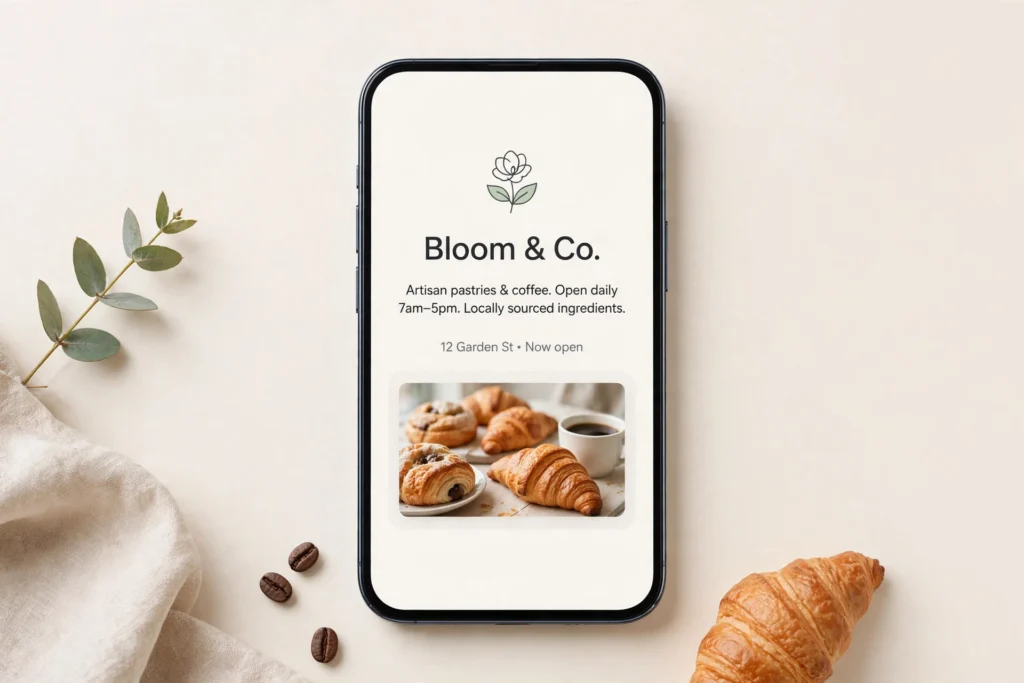
The description is not an advertisement and it is not a keyword list. It is the answer to a visitor’s question: “What is this business, and is it the right one for me?” A person reading it has usually already found you through a search; they are now deciding between you and two or three similar listings. Your description’s job is to make that decision easy.
That means it should be specific. “Plumbing services” tells the reader nothing. “Emergency and planned plumbing for homes and small landlords across Leeds, including boiler repairs, bathroom refits and landlord safety checks” tells them whether you do their job, in their area, for their kind of property. Freelancers who write descriptions for clients often keep a short checklist per client so nothing generic slips through — an organised system for those checklists saves rewriting them each time.
A simple structure that works
A description of roughly 100 to 150 words — a short paragraph or two — fits the space well and reads comfortably on a phone. Try this structure:
Sentence one: what you do and where. “We are a family-run bakery in central York, baking sourdough, pastries and celebration cakes fresh every morning.”
Sentences two and three: who you serve and what makes you different. Name the customers and the specifics: dietary options, same-day availability, specialist work, years of local trading — whatever is genuinely true and genuinely distinguishing.
Final sentence: the next step. Tell the reader what to do: call for a quote, book online, walk in and browse. A description that ends without a direction leaves the reader to work out the next move themselves.
Write in the second person where it fits: the reader is thinking about their problem, not your company history.
Choosing what to include — and what to leave out
Include: the services you most want to be hired for, the area you serve, the type of customer you serve best, and one or two real distinguishing details (same-day service, a specialism, a long local history). If your category and services list already cover the full range, the description should highlight the best of it, not repeat all of it.
Leave out: unsupported superlatives (“the best in the country”), vague passion statements, and every service you have ever offered — a description that tries to say everything says nothing. Prices, hours and contact details each have their own fields; keep them out of the description.
Keep it accurate: if you stop offering a service, remove it the same week — a customer who arrives expecting something you no longer do is a disappointed customer.
A worked example: before and after
Here is an illustrative example of a description rewrite for a fictional garden maintenance business in Bristol — not a real listing:
Before: “We are a passionate team dedicated to providing excellent garden services of the highest quality. Customer satisfaction is our number one priority and we go above and beyond for every client. Contact us today for all your gardening needs.”
That paragraph could describe any gardening business anywhere. It names no service, no area, no customer, and no reason to choose this firm over the next listing.
After: “Garden maintenance for busy homeowners across Bristol and Clifton, from regular lawn care and hedge trimming to seasonal tidy-ups and small planting projects. We visit fortnightly or monthly, bring our own tools, and leave every garden tidy on the day. Call us for a free, no-obligation quote — most visits are booked within a week.”
Same length, but now the reader knows the services, the area, the visiting pattern, and the next step. Nothing in the rewrite is a claim that cannot be checked: the services, the area and the booking pattern are all things the business actually does. If you write descriptions for clients, keeping each one specific and honest is work that a single organised routine can hold together, since every client’s description needs checking whenever their services change.
Common mistakes
Keyword stuffing. Repeating the town name and trade five times reads badly and helps nobody. Use the place and service names once, naturally, and let the category and services fields do the rest.
Copying a competitor. A description that mirrors the business up the road tells customers you have nothing of your own to say — and if the competitor’s claims are wrong for you, you inherit their errors.
Writing for Google instead of people. If it sounds written to impress a search engine, it fails at its only job.
Letting it go stale. Re-read yours every few months, and after any significant change to the business.
Getting the category right matters here too: the description supports the category, it does not replace it. If the category is wrong, even a perfect description will be shown to the wrong searches, so make sure you have chosen the right primary category before polishing the words around it.
A note for readers in the UK, US, Canada and Australia
Description writing is the same in all four countries, with one genuine difference: spelling and local terms. Use the spelling your customers use — “organise” in the UK, “organize” in the US — and their words: “estate agent” versus “realtor”, “flat” versus “apartment”. Write in your customers’ language, in a single description.
Questions owners ask next
Should I put prices and opening hours in the description?
No. Prices, hours and contact details each have their own fields on the profile, and repeating them in the description wastes the space and creates a second copy that can quietly go out of date. The description’s job is the decision: what you do, who you serve, why you. A reader who has decided can find the hours in their proper field in one tap.
Can I say we are “the best in town” if our customers say so?
Leave superlatives out, even flattering ones. Unsupported claims like “the best in the country” cannot be checked by the reader, so they persuade nobody — and a description should contain nothing that is not genuinely true and genuinely distinguishing. Replace the claim with the specific underneath it: same-day availability, a real specialism, years of local trading. Specifics are what a stranger can actually decide on.
My description just repeats my services list — is that a problem?
Yes, in the sense that it wastes the one piece of writing a deciding customer reads. If your category and services list already cover the full range, the description should highlight the best of it, not repeat all of it: the services you most want to be hired for, the customers you serve best, the detail that separates you. A description that tries to say everything says nothing.
How often should I rewrite my description?
Re-read it every few months, and after any significant change to the business. Keep it accurate as a standing rule: if you stop offering a service, remove it the same week, because a customer who arrives expecting something you no longer do is a disappointed customer. Most rewrites are small — a service swapped, an area updated — but they are what keep the description an honest answer to “what is this business, and is it right for me?”
What to do next
Read your current description out loud. If a stranger could not tell from it what you do, where you do it, and who it is for, rewrite it using the structure above: what and where, who and why, then the next step. Keep it to a short paragraph, check every claim is true, and set a reminder to re-read it in three months. If you write descriptions for clients and want the profiles, services and reporting organised in one routine, you can see the system I use on my Local Alchemist AI page. Note that it is a tool you run yourself: buyers need their own hosting and their own API keys, and AI output needs a human review before anything goes live — it is never fully automatic.
Disclosure: the page linked above contains an affiliate link. If you buy through it, I may earn a commission at no extra cost to you.