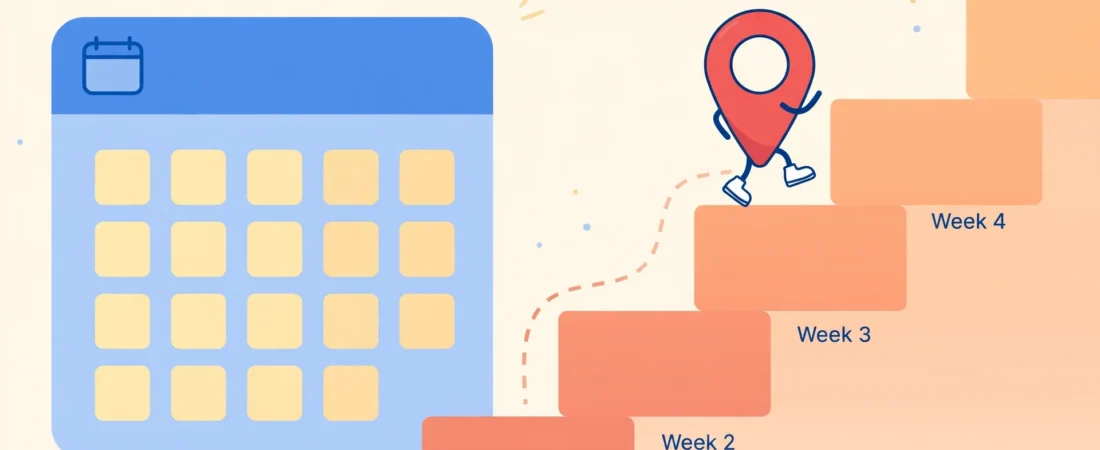
“How long until I rank?” is the first question almost every local business owner asks, and the honest answer is the one nobody wants to sell: there is no fixed timeline, and anyone who guarantees you a position by a date is guessing at best. What does exist is a pattern — a rough order in which things tend to change, and the factors that speed it up or slow it down. This article lays out that pattern honestly, so you can set expectations you can actually keep.
The short answer
There is no fixed timeline for ranking on Google Maps, and nobody can honestly guarantee a position by a date. Fixes like category and completeness can land in the first two weeks; first real movement usually appears in weeks 3–8, nearby searches first; months 3–6 are where prominence compounds. Your town, competition and starting point set the pace.

Why no one can give you a date
Google Maps ranking depends on relevance, distance, and prominence, and all three move at different speeds. Relevance can change in a day: fix a wrong category and you can match searches you previously missed. Distance barely changes at all unless you move or correct your service area. Prominence — reviews, photos, completeness, mentions elsewhere — builds slowly, because it is earned over weeks and months, not switched on.
Competition matters too. Outranking one quiet competitor in a small town is a different job from outranking forty active competitors in a big city. Your starting point matters as well: a brand-new profile with no reviews starts further back than a five-year-old profile with eighty reviews that has simply been neglected. Anyone quoting a single timeline without asking about your town, your competition, and your starting point is not giving you a timeline — they are giving you a sales line.
The first two weeks: fixes that show fast
In the first fortnight, the wins are the fixes, not the ranking jumps. Correcting a wrong primary category, completing an empty description, listing your real services, fixing opening hours, and adding your first photos can all be done in a few evenings. If your profile was not showing at all because of a verification or suspension problem, resolving that is also a first-two-weeks job — and the Maps visibility checks cover that side of it.
Think of it as clearing the track, not winning the race. If you manage this for clients, a repeatable first-fortnight checklist keeps every fix from being forgotten halfway through.
Weeks 3–8: the first visible movement
This is usually when the first real movement appears, and it appears unevenly. You may start showing for your exact business name reliably, then for your trade plus your neighbourhood, while city-wide searches still show competitors above you. That unevenness is normal: distance means you win nearby searches before wider ones.
What drives movement in this phase is consistency, not volume. Two or three genuine reviews a week, a few real photos a month, replies to every review, and a profile kept up to date will do more than a single burst of activity followed by silence. Never offer anything in exchange for a review, and never selectively ask only customers you expect to be positive — review gating is prohibited, and a short burst of suspicious reviews can do more harm than months of steady ones.
Months 3–6: where the real ranking is built
By months three to six, prominence starts to compound. A profile that has gained reviews steadily for a quarter, added photos regularly, and kept its information complete will usually hold a visibly better position than it started with — particularly for searches near the business. This is also the phase where wider searches begin to move, because the review total and the completeness signals are now strong enough to offset some of the distance disadvantage against competitors further away.
This is also where most businesses quit, as gains slow just as the work becomes routine. The businesses that keep going are the ones that still hold their position a year later. Keeping that routine going across several clients is easier with a monthly routine that tracks reviews and photos in one place.
An illustrative timeline: the neglected bakery
Here is a clearly illustrative timeline, not measured data, for a fictional bakery in Cardiff — call it Crumb & Co. — starting from a neglected profile: 9 reviews, 3 photos, an incomplete description, and position 11 for “bakery Cardiff”.
- Weeks 1–2: Category corrected, description written, services listed, 8 photos added. Position for its own name: now reliable. Position for “bakery Cardiff”: still around 10.
- Weeks 3–8: Reviews requested from every customer at the till with a simple card; 11 new reviews arrive, roughly 2 a week. Photos added weekly. Position for neighbourhood searches: inside the top 5. City-wide: around 7.
- Months 3–4: Review total reaches 32, photos reach 30, every review replied to. Position for neighbourhood searches: regularly in the top 3. City-wide: around 5.
- Months 5–6: Review total reaches 44. Position for city-wide searches: occasionally in the top 3 on quieter days, usually 4–5.
Notice what this timeline does not promise: the bakery never reaches a permanent number 1, and the city-wide top 3 comes and goes with searcher location and competitor activity. That is what honest progress looks like — a trend upward, not a guaranteed slot. A business in a quieter town with fewer competitors could move faster; a business in central London competing with hundreds could move slower. Your town sets your timeline more than any tactic does.
What speeds it up, and what slows it down
Faster: an accurate category from day one, a review habit that starts immediately, genuine photos added regularly, and a complete profile kept complete. A competitor going quiet helps too, though you cannot control that.
A labelled note on country differences
The timeline pattern is the same in the UK, US, Canada, and Australia, because it follows Google’s ranking factors rather than any local rule. The genuine difference is competition density: a business in a small Canadian or Australian town may move faster simply because fewer competitors are active, while a business in a large US city faces more competitors and a longer climb. Search habits differ slightly too — UK searchers often add the town name, US searchers often use neighbourhood names — but that changes which searches you track, not how long ranking takes.

Questions owners ask next
Can I speed things up by getting a lot of reviews quickly?
No — and attempting it can set you back. What drives movement in weeks 3–8 is consistency, not volume: two or three genuine reviews a week will do more than a single burst followed by silence. Never offer anything in exchange for a review, and never selectively ask only customers you expect to be positive: review gating is prohibited, and a short burst of suspicious reviews can do more harm than months of steady ones.
I rank for my business name but not for my trade in town — is something wrong?
Probably not; that unevenness is the normal order of movement. A profile usually starts showing reliably for its exact name first, then for trade-plus-neighbourhood searches, while city-wide searches still show competitors. Distance explains the sequence: you win nearby searches before wider ones. Judge the trend across all three search types rather than expecting them to move together.
How should I track progress without checking my position every day?
Record your position for three searches — your name, your trade plus your neighbourhood, and your trade plus your town — once a week, from two or three places in town, and set a 90-day check-in rather than a 30-day verdict. Daily checking measures noise: positions shift with the searcher’s location and competitor activity. The weekly record is what shows you the honest trend, up or flat, that decisions should be based on.
Does it matter whether I start from a neglected old profile or a brand-new one?
Yes — your starting point is part of your timeline. A brand-new profile with no reviews starts further back than a five-year-old profile with eighty reviews that has simply been neglected; the neglected one is reactivating prominence the new one still has to earn. That is also why a single quoted timeline, your town, your competition and your starting point, is a sales line rather than an answer.
What to do next
Set a 90-day check-in, not a 30-day verdict. Fix the category and completeness this week, start the steady review habit, and record your position for three searches — your name, your trade plus neighbourhood, and your trade plus town — once a week from two or three places in town. For the wider UK Maps picture, see how UK small businesses can rank higher on Google Maps. If you do this for clients and want the fixes, the review habit, and the weekly position checks kept in one organised place, you can see the system I use on my Local Alchemist AI page. It needs your own hosting and your own API keys, and its AI output needs a human review before anything goes live — it organises the timeline, it cannot shorten Google’s.
Disclosure: the page linked above contains an affiliate link. If you buy through it, I may earn a commission at no extra cost to you.