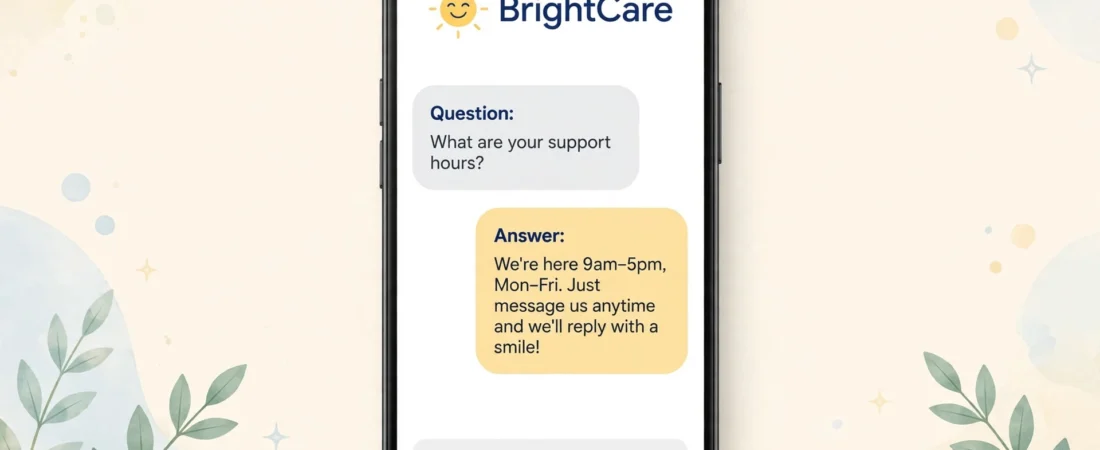
Many owners never notice the Questions and Answers section on their Google Business Profile until a stranger has filled it in: anyone searching for your business can ask a question there, and anyone — including other customers — can answer it.
The owner can answer too, and the owner’s answers carry visible authority. Answering the right questions first turns a neglected corner of your profile into a quiet sales tool.
The short answer
Anyone can ask — and anyone can answer — questions on your Google Business Profile, but the owner’s answers carry visible authority. Answer first the questions that stop a customer contacting you: services, area, hours, pricing approach, practical details, appointments. You may also seed the section with genuine questions your customers really ask, answered honestly.

How the Q&A section works
Visitors can post a question — “Do you offer parking?”, “Do you take card payments?”, “Are you open on Sundays?” — and answers appear publicly beneath it. The owner can answer directly, and can also ask and answer their own questions to cover what customers most often want to know.
Seeding the section with genuine, frequently asked questions and honest answers is legitimate: it publishes useful information where customers already look. What is not legitimate is inventing questions to plant false claims, or posting fake answers under another identity.
For freelancers handling several client profiles, that weekly glance is exactly the kind of small recurring job that an organised client system keeps from slipping.
The questions to answer first
Start with the questions that stop a customer from contacting you. In rough priority order:
1. “Do you offer [the service I need]?” If a service is commonly asked about and you offer it, say so plainly, with any condition that matters — for example, that it is by appointment only.
2. “Where are you / do you cover my area?” For a storefront, confirm the location in plain terms. For a business that travels, state the areas covered, matching what your profile already says.
3. “When are you open?” Answer with the actual hours, including any seasonal change, rather than pointing the reader elsewhere.
4. “How much does it cost / do you offer free quotes?” You need not publish a price list, but say how pricing works: free quotes, fixed prices, or prices on request — and what the next step is.
5. “Do you take card payments / is there parking / is it accessible?” Practical questions like these decide visits. Answer them factually and briefly; one sentence is usually enough.
6. “Do I need an appointment?” Walk-in versus appointment-only is a common source of wasted trips. State it clearly.
Work through this list and you will have covered most of what real customers actually ask.
How to write a good answer
A good Q&A answer is short, factual, and complete in itself. A few rules:
- Answer the question asked, not the one you wish had been asked. If someone asks about parking, answer about parking — do not reply with a sales pitch.
- Keep it to two or three sentences — long answers get skimmed, not read.
- Be specific. “Yes, we have free parking behind the building on Market Street” beats “Yes, parking is available.”
- Stay honest about limits. If you do not offer something, say so and suggest the closest alternative you do offer.
- Keep the tone friendly and professional: every future customer may read these answers.
If a question is rude or misleading, answer calmly and factually once, and leave it. Future readers judge the tone of the answer more than the tone of the question.
A worked example: seeding a profile’s Q&A
Imagine a small dental practice in Cardiff — an illustrative example, not a real business. The owner finds the Q&A section empty: no questions, no answers, and no help for anyone deciding whether to call. Here is the sequence she follows:
- List the five questions her reception team hears most often: Do you take new NHS patients? Do you offer evening appointments? Is there parking? Do you treat children? How do I book?
- Write one honest answer for each. For the NHS question, the honest answer is that the practice is currently private-only with a waiting list — she says exactly that, rather than leaving it to guesswork.
- Post them over a single afternoon, set a weekly reminder to answer new visitor questions within a few days, and review the answers every few months — updating parking when charges change, and hours before Christmas.
After a month, the section answers the most common pre-booking questions before a single phone call is needed: Q&A removes friction between finding the business and contacting it. Before seeding anything, check the rest of the profile is in order — a full profile audit catches gaps in hours, services and categories that Q&A alone cannot fix.
Handling difficult questions
Some questions are awkward: a complaint dressed as a question, or something you cannot answer publicly for privacy reasons. The approach matches the guidance in our article on how to reply to Google reviews: stay calm, be factual, move anything personal to a private channel, and never share a customer’s private details publicly.
If a question contains false information — wrong hours, a service you never offered — correct it politely with the facts. Future readers will trust the correction more than silence.
Mistakes to avoid
Ignoring the section entirely. An unanswered question — or a wrong answer from a stranger — sits there indefinitely.
Answering with a sales pitch. Readers want information, not a brochure; a pitch in place of an answer reads as evasion.
Planting fake questions. Invented praise, or answers posted under false identities, are dishonest and easy to spot. Genuine frequently asked questions are plentiful — use those.
Letting answers go stale. Hours, prices and parking change, and an answer right last year but wrong today misleads the customers it was meant to help.
For freelancers managing Q&A across several clients, the weekly check is easy to forget. Keeping it inside an organised client routine stops a client’s Q&A section sitting unanswered for months.
A note for readers in the UK, US, Canada and Australia
Q&A works the same way in all four countries. The genuine differences are in the questions themselves: parking and public-transport questions dominate in UK cities, payment and insurance questions come up more in the US, and holiday-hours questions cluster around different dates in Australia. Seed your section with your own customers’ questions, not a generic list imported from another country.

Questions owners ask next
Is it cheating to post my own questions on my profile?
No — seeding the section with genuine, frequently asked questions and honest answers is legitimate, because it publishes useful information where customers already look. What is not legitimate is inventing questions to plant false claims, or posting fake answers under another identity. The test is simple: use the questions your reception team, inbox or counter staff actually hear, and answer them truthfully.
A stranger has answered a question about my business — and got it wrong. What do I do?
Answer it yourself, as the owner, politely and with the facts. If a question contains false information — wrong hours, a service you never offered — a calm correction from the business carries visible authority, and future readers will trust the correction more than silence. Ignoring the section entirely is the real mistake: an unanswered question, or a wrong answer from a stranger, sits there indefinitely.
How quickly should I answer new questions?
Within a few days is a good standard. Set a weekly reminder to check the section, answer anything unanswered — starting with the questions that stop someone booking — and treat it as the small recurring job it is. In the worked example above, a weekly check plus a review of the answers every few months kept a dental practice’s section answering pre-booking questions before a single phone call was needed.
Should my answers try to sell a little?
No. Answer the question asked, not the one you wish had been asked: if someone asks about parking, answer about parking. Keep it to two or three sentences, be specific — “free parking behind the building on Market Street” beats “parking is available” — and stay honest about limits. A sales pitch in place of an answer reads as evasion, and readers want information, not a brochure.
What to do next
Open your profile’s Q&A section today. If it is empty, post honest answers to the five questions your customers ask most often this week. If it already has questions, answer the unanswered ones first, starting with those that stop someone booking. Then set a weekly reminder to check again. If you manage profiles for clients and want the Q&A checks, reviews and reporting organised in one routine, you can see the system I use on my Local Alchemist AI page. Note that it is a tool you run yourself: buyers need their own hosting and their own API keys, and AI output needs a human review before anything goes live — it is never fully automatic.
Disclosure: the page linked above contains an affiliate link. If you buy through it, I may earn a commission at no extra cost to you.