
Sooner or later, a business that wants more local work asks its web designer the same question: “Should we have a page for every service in every town?” The instinct is understandable — more pages, more chances to be found. But service pages vs location pages is not a “both, maximally” decision. Done right, the structure quietly matches how customers search and how Google ranks. Done wrong, it manufactures twenty thin duplicate pages that Google ignores and that can drag the whole site’s quality down. This article separates the two page types, shows what each is for, and draws the line between a genuine location page and a doorway.
First, one piece of orientation: for most local searches, your Google Business Profile does more work than your website does — the relationship is explained in Google Business Profile vs a website. Website pages matter most for the searches where customers compare and read — and for giving Google clear, detailed signals about what you do and where. Businesses organising that work often keep the page plan alongside their profile work in one content tracker so the two never drift apart.
The short answer
A service page covers one thing you sell, written in full; a location page covers one place you genuinely operate, filled with detail true only of that place. Build the combinations you can write about honestly. Twenty copied town pages with the name swapped are doorway pages — Google ignores them and they drag site quality down.
Service pages: one page per thing you sell
A service page exists for one service, written properly: what it involves, who it is for, what it typically costs or how pricing works, how the job runs, questions customers ask. “Boiler installation”, “Emergency call-outs”, “Bathroom refits” — each its own page, each genuinely useful to a person considering that service.
Service pages earn their keep three ways. They match the way customers actually search (“boiler installation cost” is a real query a homepage cannot answer well). They give you something specific to link to from the matching service entry on your Google Business Profile. And they convert: a visitor reading about exactly the job they need is far closer to calling than a visitor browsing a generic homepage. A service page also gives offline marketing somewhere honest to land — the QR code on a van or a leaflet can point to the exact service, not a homepage that makes the customer hunt for it. If a service is real and distinct, it deserves a page. If two “services” differ only in name, they deserve one page between them.
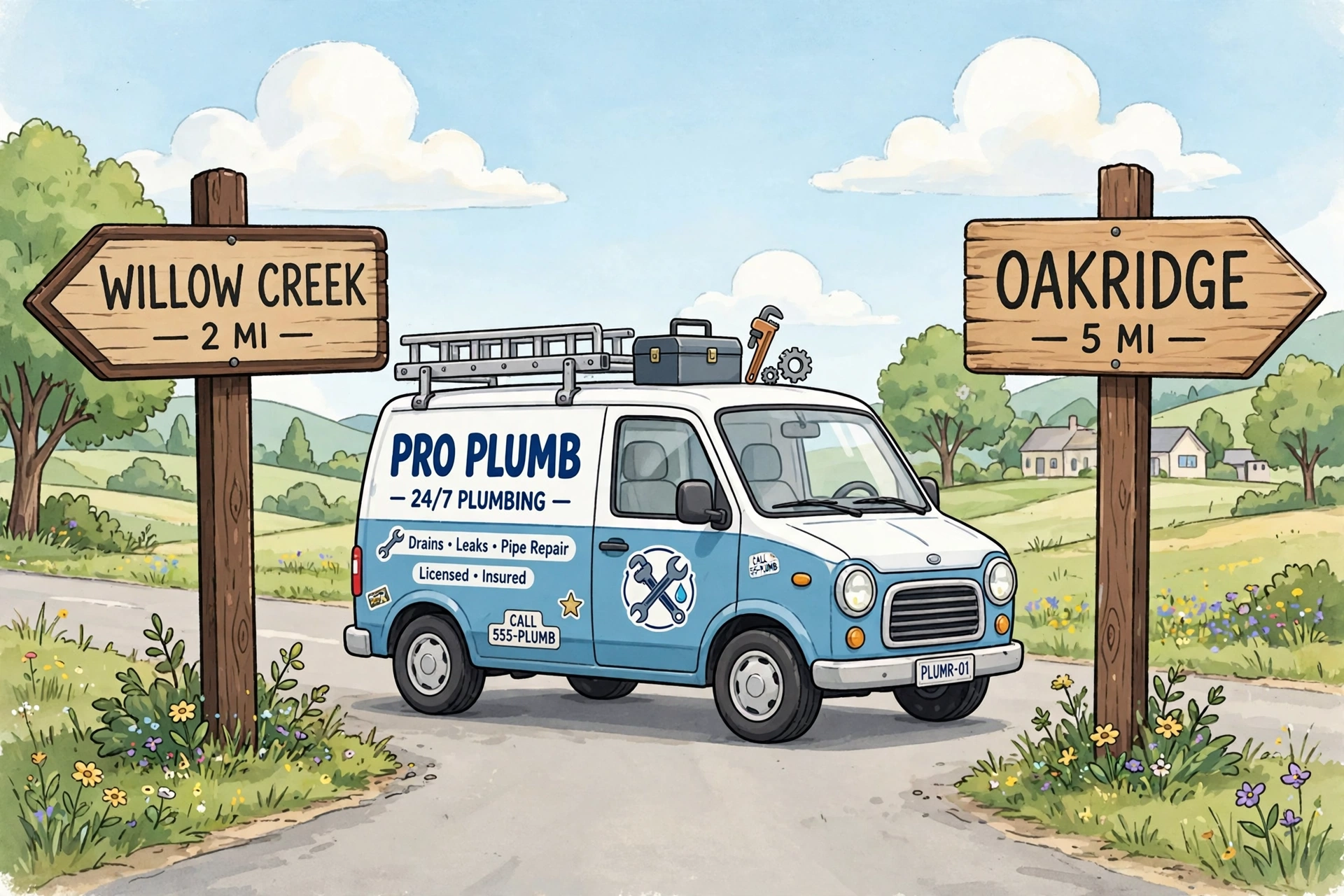
Location pages: one page per place you genuinely operate
A location page exists for one place where the business has a real presence: a branch, an office, or — more carefully — an area it physically serves with real work there. A good location page contains things that are true only of that place: the local address or coverage detail, photos of work done there, reviews from customers there, staff or depot details, local specifics a resident would recognise.
That last test is the whole game. Content that is true only of that place makes a location page legitimate. A location page is also where a customer lands when a review or a friend names the branch, so the practical details — opening hours, parking, which entrance — matter more there than any keyword does. Content that would read identically with the town name swapped makes it a duplicate wearing a costume — and Google’s spam policies treat mass-produced location pages as doorway pages, created to funnel searches rather than serve anyone.
A worked example: a plumber’s sitemap, two ways
Here is a fictional plumbing business serving a city and its suburbs, structured properly:
The good version — 4 service pages + 2 location pages:
- Service pages: Emergency plumbing · Boiler installation · Bathroom fitting · Drain unblocking — each written in full, with process, pricing guidance and FAQs.
- Location pages: one for the home city, where the business is based, with its address, team and local reviews; one for the neighbouring town where it has a genuine second base and a visible share of its work.
- Result: 6 substantial pages, every one defensible. A human can read any page and learn something true and specific.
The bad version — 20 copied town pages:
- One template, twenty towns, the name swapped in the title and three sentences: “Looking for a plumber in [Town]? We offer plumbing services in [Town]…”
- No local proof on any of them — no jobs done there, no reviews from there, sometimes no real work there at all.
- Result: Google indexes a few, ignores or drops the rest, and the pattern is exactly the scaled, thin content that site-quality systems are built to discount. The business has also spent its content budget on pages no customer would ever choose to read.
The contrast is not about page count. Six honest pages beat twenty costumes. If you are researching which towns and services customers actually search for before committing, the free method in how to do local keyword research keeps the plan grounded in real queries rather than guesswork.
The decision rules
When you are unsure whether a page should exist, run these three questions:
- Could I write 400 honest words about this service or place without repeating another page? If not, it does not get its own page.
- Is there something true here that is true nowhere else on my site? A real base, real reviews, real local detail — if the answer is no, merge it into the nearest genuine page.
- Would I happily show this page to a customer from that town? If you would be embarrassed, Google will not reward it either.
And a structural note: whatever pages you build, each location page should connect cleanly to that location’s own Google Business Profile, and each service page to the matching profile service entry. Site and profile telling the same story is the foundation what local SEO is builds on. Freelancers auditing client sites usually record the page plan alongside the profile audit in one client workspace, so thin pages get merged or cut before they are ever published rather than cleaned up afterwards.

Questions owners ask next
How do I decide whether a page deserves to exist?
Run three questions. Could you write 400 honest words about this service or place without repeating another page? Is there something true here that is true nowhere else on your site — a real base, real reviews, real local detail? And would you happily show this page to a customer from that town? If any answer is no, the content belongs merged into the nearest genuine page, not on a page of its own.
Two of my services are almost the same. Do they each get a page?
Only if they are real and distinct. A service page earns its keep by answering one service properly — what it involves, who it is for, how pricing works, how the job runs. If two “services” differ only in name, they deserve one page between them. Pages multiply honestly with the work itself, not with the labels you can invent for it.
Should my pages connect to my Google Business Profile?
Yes — site and profile should tell the same story. Each location page should connect cleanly to that location’s own profile, and each service page to the matching service entry on the profile. That link also works for customers: a service page gives the profile something specific to point at, and it is where offline marketing — the QR code on a van or a leaflet — can honestly land.
I already have twenty thin town pages. What do I do with them?
Audit them against the three questions and keep only the ones with something true and specific to say. Merge or delete the rest, and resist adding a town until you have real work and real reviews there to write about. Six substantial pages, every one defensible, beat twenty costumes — Google indexes a few of the thin ones, ignores or drops the rest, and the pattern is exactly the scaled content its site-quality systems are built to discount.
What to do next
Sketch your site’s page plan on one sheet of paper this week: list your real services down one side and your genuinely-served places across the top, then mark only the combinations you could write about honestly and specifically. Build those pages, merge or delete the rest, and resist adding a town until you have real work and real reviews there to write about. If you manage this content work for clients and want the pages, profiles and reviews kept consistent in one system, you can see the setup on my Local Alchemist AI page.
Disclosure: the page linked above contains an affiliate link. If you buy through it, I may earn a commission at no extra cost to you.