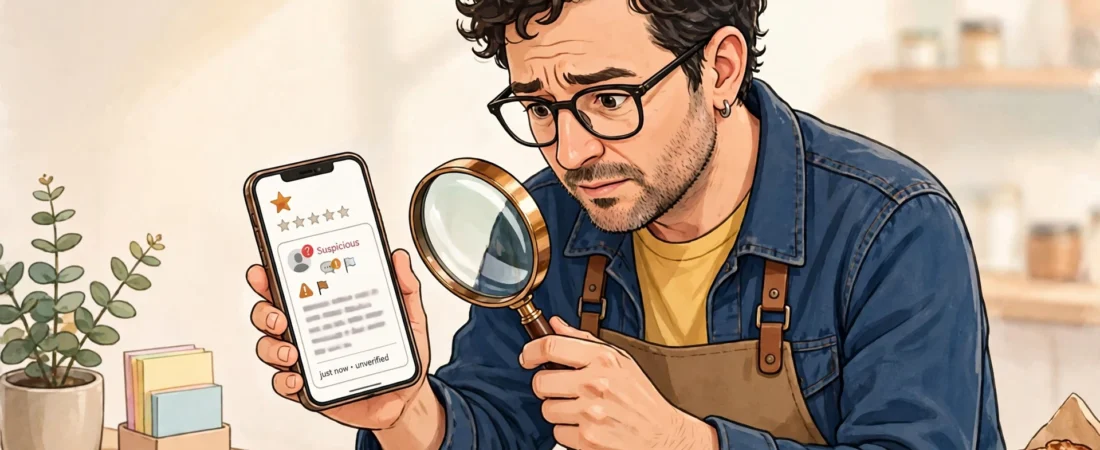
A review appears from someone you have never served, praising a service you do not offer — or trashing a job that never happened. Fake Google reviews are a real problem, and they feel deeply unfair. If you look after reviews for several clients, a dashboard flagging new reviews the day they appear makes spotting fakes far less stressful; the system I use is described on this review monitoring setup.
The short answer
A fake Google review is one not based on a genuine experience — from someone never served, paid for, or misrepresenting the business. Spot it with five checks: your records, the reviewer’s profile, the details, patterns, and your team. Report it through your profile with a factual note, reply once neutrally in public, and never buy reviews to balance it.
What counts as a fake review
Google’s review policies prohibit reviews not based on a genuine experience, including reviews by people who never used the business, reviews written in exchange for payment or incentives, and reviews that misrepresent the business. A harsh review from a real customer is not fake, however unfair it feels — that is a service problem, not a policy violation. Keeping that distinction clear matters, because reporting genuine reviews as fake wastes your time and undermines your credibility.
Let me be direct: buying reviews is not a shortcut and not a viable tactic. Google prohibits incentivised reviews, and bought reviews risk removal, plus damage to your profile if traced back to you. The honest route is slower but it is the only one that survives. If you want more genuine reviews instead, my guide to how to get more Google reviews without sounding pushy covers legitimate ways to ask.
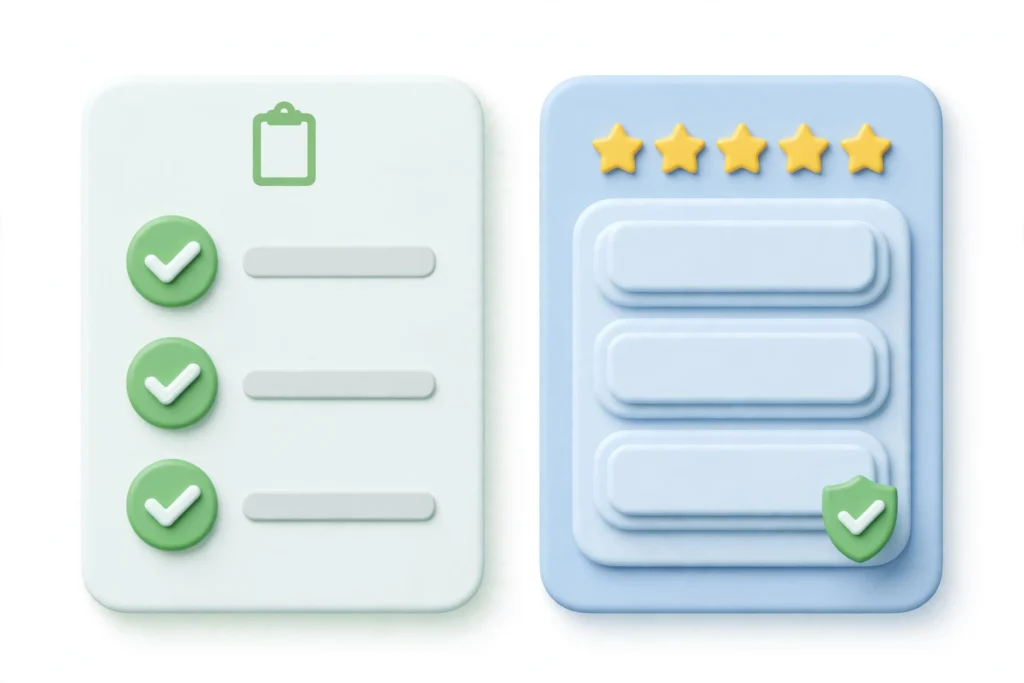
How to spot a fake review: a 5-point check
Work through this check sequence first. An illustrative example: a café in Bristol receives a one-star review from “Dave K.” claiming cold food and rude staff on a Sunday. The owner runs these five checks:
- Check your records. Search bookings, till records, and staff rotas for the name, date, and details. The café finds no “Dave K.” anywhere, and no Sunday service matching the description.
- Read the profile. Click the reviewer’s name. A profile with one review, no photo, and reviews scattered across unrelated cities and trades is a warning sign — though a genuine new customer can look like this too, so it is never proof alone.
- Check the details. Fake reviews often get specifics wrong: a service you do not offer, a product you never sold, a branch that does not exist, or hours you never kept.
- Look for patterns. Several negative reviews arriving in a burst with similar phrasing, or several five-star reviews for a competitor appearing at the same time, all deserve a closer look.
- Ask your team. A two-minute question — “Did anyone serve someone matching this on Sunday?” — settles many cases before they escalate.
In the café example, checks 1, 3, and 5 point the same way: no record, wrong details, no staff memory. That is enough to report with confidence, with a note of exactly why.
How to report a fake review, step by step
Only a verified owner or manager of a verified profile can manage reviews through Google Business Profile. The route, in order:
- Open your profile and go to Read reviews.
- Find the review in question.
- Use the report option and choose the reason that fits — for a fake review, that it is not based on a genuine experience.
- Add a brief, factual note of why: no record, wrong service, or the pattern you found. Stick to facts you can evidence.
- Submit, and note the date.
There is no guaranteed timeline, and Google does not always explain the outcome. Do not re-report repeatedly; one clear report beats five frustrated ones. If the review is defamatory or abusive, the same route applies; you can also seek legal advice separately, but the reporting step comes first and costs nothing.
What to say publicly while you wait
Do not leave a fake review unanswered while it is under review — readers will assume it is real. Reply once, neutrally, never accusing the reviewer in public:
“We have no record of this visit, and the details do not match our services, but we’d like to look into it — please contact us directly so we can check.”
That single reply does three jobs: it tells future readers you are paying attention, signals doubt without starting a public argument, and invites a genuine customer to come forward. My guide to how to reply to Google reviews has more example replies for awkward cases, including keeping your tone steady when a review feels personal.
Never share a reviewer’s private details or customer records, and never offer anything in exchange for removing or changing a review. Those lines protect you even when the review itself is dishonest.
What never to do about fake reviews
- Do not buy positive reviews to balance them. This is prohibited, risks removal, and can damage your profile far more than the fake review did.
- Do not ask friends or staff to post reviews. Reviews must come from genuine customers; staff reviews of their own employer are a policy problem.
- Do not flood the reviewer with replies. One measured reply, then let the report run its course.
- Do not copy the same reply under every review. Readers notice.
- Do not ignore a pattern. If fake reviews keep arriving, keep a log: dates, reviewer names, wording, and report dates.
Protecting your profile going forward
The best defence is a steady stream of genuine reviews. A profile with forty recent, specific, genuine reviews absorbs one fake review far better than a profile with six. That means asking every happy customer at the right moment, in a natural way — never selectively asking only customers you know are happy while discouraging unhappy ones, which is review gating and is prohibited. Ask everyone, accept what comes, and reply to all of it.
A simple routine: check for new reviews twice a week, run the five-point check on anything suspicious the same day, report what fails, and reply to everything else. If you manage reviews for clients, that routine multiplied across ten profiles is real work — which is why a system that gathers reviews, drafts replies, and builds reports in one place earns its keep. The system I use is described on this review management setup, and whichever tool you choose, the human check above still comes first.

Questions owners ask next
A real customer’s review is harsh and unfair — can I report it as fake?
No. A harsh review from a genuine customer is not fake, however unfair it feels — that is a service problem, not a policy violation. Reporting genuine reviews as fake wastes your time and undermines your credibility with Google. The honest route is the one that works on readers: a calm, specific reply, the problem fixed where it is real, and your genuine review flow continuing.
How long does it take Google to remove a reported review?
There is no guaranteed timeline, and Google does not always explain the outcome. That is why the public reply matters so much: while the report runs its course, one neutral reply — no record of the visit, details do not match, please contact us — protects you with every future reader. Do not re-report repeatedly; one clear report with a factual note, and the date logged, beats five frustrated ones.
Can I offer the reviewer something to take the review down?
Never. Offering anything in exchange for removing or changing a review is prohibited, and it exposes you even when the original review was dishonest. The same discipline protects you in the other direction: never share a reviewer’s private details or customer records in public, and never flood the review with replies. One measured reply, the report filed, and then let the process run.
A competitor’s profile is filling with suspicious five-star reviews — what can I do?
Focus on what you control, because it is also what actually protects you: a steady stream of genuine reviews of your own. A profile with forty recent, specific, real reviews absorbs a fake far better than a profile with six — and sudden bursts of perfection are exactly the pattern Google’s filters and readers both learn to distrust. Keep your own log of dates, names and wording for anything suspicious on your profile, and keep asking real customers honestly.
What to do next
If a suspicious review is sitting on your profile now, run the five-point check today: records, reviewer profile, details, patterns, team. If it fails, report it through Read reviews with a short factual note, post one neutral public reply, and log the date. Then keep asking genuine customers for honest reviews — that steady stream makes the next fake review a footnote. If you handle reviews for clients and want monitoring and reporting organised in one place, see my Local Alchemist AI page. Note the honest terms: it needs your own hosting and your own API keys, and its AI drafts need a human review before posting.
Disclosure: the page linked above contains an affiliate link. If you buy through it, I may earn a commission at no extra cost to you.