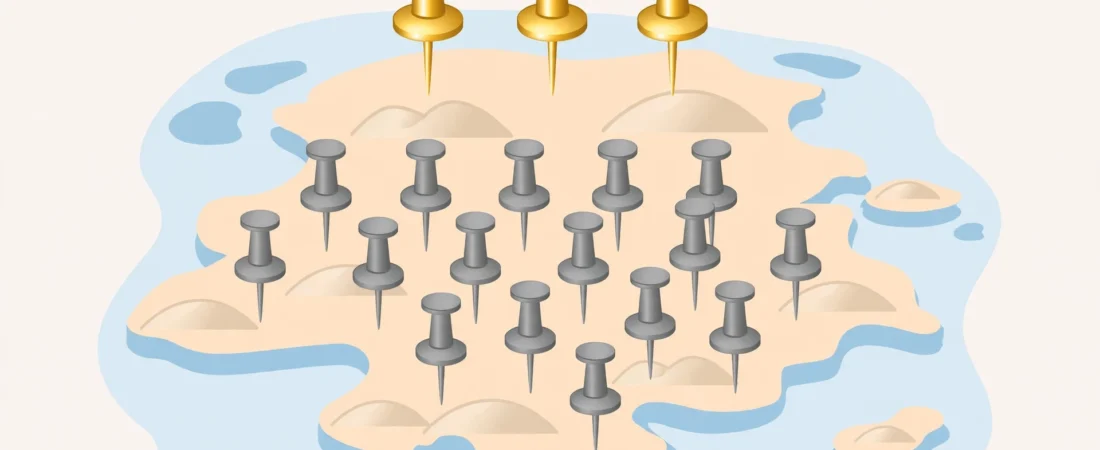
Search for almost any local service and the first thing you see after the ads is a small map with three businesses listed underneath. That box is the Map Pack, and those three spots win a large share of the calls, because most searchers never scroll past them. Getting into the top 3 is not luck, and it is not something you buy. It is the result of being the best match on relevance, distance, and prominence for that particular search.
This article is about ranking into those three spots — a different job from simply appearing on Maps at all. If your profile does not show up anywhere, fix visibility first with the Maps visibility checks. If you already appear but sit below the top 3, read on.
The short answer
To get into the Google Map Pack top 3, be the best match on relevance, distance and prominence — the three things Google weighs for every local search. In practice: the exact primary category customers search for, a full services list in their words, and a steady flow of recent reviews and photos. Win the searches near you first.
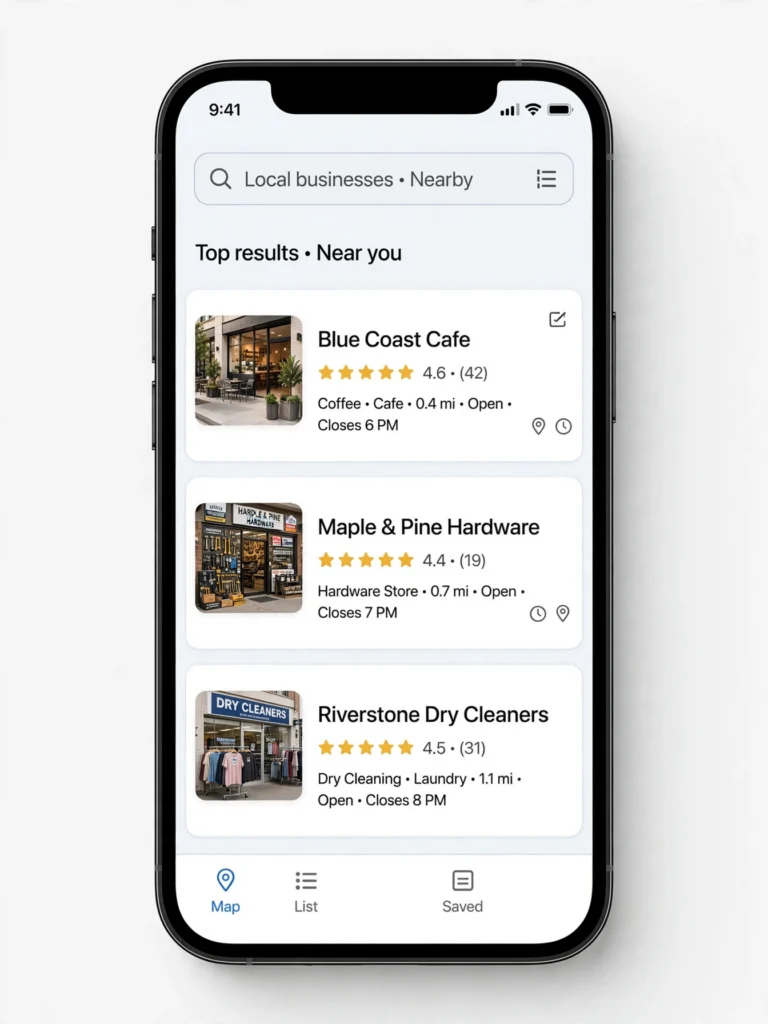
What the Map Pack actually is
The Map Pack shows the three businesses Google judges most relevant, closest, and most prominent for the searcher’s query and location. It changes with the searcher: someone searching from the north side of town may see a different top 3 from someone searching downtown, because distance is personal. It also changes over time as reviews arrive and profiles are updated. That means “top 3” is not one fixed leaderboard — it is a set of small, local contests, and you can win the ones near you even if you cannot win the whole city.
Relevance: match the query, not the industry
Relevance is the lever most businesses get wrong. Google matches the search phrase to your primary category first, then to your services, description, and the words in your reviews. A roofer whose primary category is “roofing contractor” and whose services list “roof repair, gutter replacement, flat roofing” will match “roof repair” searches far better than a roofer listed under “general contractor” with an empty services section.
Check your own profile now: is your primary category the exact service customers search for? Are your ten most-requested services listed, in the words customers use? Is your description written about what you do for customers, not a slogan? Each of these is a relevance signal, and together they decide whether Google even considers you for a given query. If you run this check for several clients, a repeatable profile audit routine keeps the category and services checks from being skipped.
Prominence: the trust signals you can build
Prominence is where steady work pays off. The signals that feed it include review count, rating, and recency; the number and freshness of photos; how complete the profile is; and whether the business is mentioned elsewhere on the web in consistent detail.
Reviews deserve the most attention because they move fastest. A profile gaining two or three genuine reviews a month will steadily outrank a profile whose last review is a year old, even if the older profile once had more reviews in total. Ask every satisfied customer, make it easy with a direct link, and reply to every review. Never offer anything in exchange for a review, and never ask only the customers you expect to be positive — selectively soliciting only positive reviews, known as review gating, is prohibited.
Photos matter more than most owners expect. Genuine photos of real work, the team, and the premises, added regularly, signal an active business. Ten photos added this year beat fifty photos added in 2021 and never touched since.
Completeness is the unglamorous part: hours kept up to date, services listed, description filled in, attributes that genuinely apply, questions in the Q&A section answered. Each completed field is a small relevance and prominence signal, and together they add up.
Distance: play the ground you can win
You cannot move your premises, but you can stop wasting distance. Make sure your address is accurate and your service area genuinely covers the towns you serve — a service-area business with a too-narrow area is invisible to searchers just outside it. Keeping service areas accurate across several clients is easier with a single organised workflow. Then focus on winning the searches near you: the top 3 for searches from your own neighbourhood is a realistic first goal, and those wins bring the reviews and prominence that later help you in wider searches.
An illustrative example: from position 8 to the top 3
Here is a clearly illustrative example, not measured data, showing how the levers combine. A fictional café in Bristol — call it Rosa’s — sat around position 8 for “café Bristol” and never made the Map Pack. Its owner compared the top 3 and found: her primary category was “coffee shop” while the leaders used “café”; she had 31 reviews against their 90, 120, and 75; she had 9 photos against their 40-plus; and her description was one sentence long.
Over 16 weeks she fixed the category, rewrote the description around what customers actually order, added 4 photos a month, and asked every regular for a review, gaining 26 new reviews — about 1.6 a week. By week 16 she had 57 reviews, 25 photos, and a matching category, and she began appearing in the Map Pack for searches from her own side of the city, though not yet for city-centre searches where distance favoured the leaders. That is the honest shape of progress: the top 3 comes first for nearby searches, and wider wins follow later.
Mistakes that keep you out of the top 3
Keyword-stuffing your business name — “Best Plumber Leeds Cheap Emergency” — can get the profile suspended and your ranking wiped out. Buying reviews risks removal of the reviews and a trust penalty that is hard to recover from. Ignoring your profile for months while competitors add reviews and photos every week is the quietest mistake of all: you do not fall because of one bad move, you fall because everyone else kept moving.
A labelled note on country differences
The Map Pack works the same in the UK, US, Canada, and Australia, and the three factors apply everywhere. The genuine differences are search habits: UK searchers often add the town name, US searchers often use neighbourhood names, and in all four countries “near me” searches depend heavily on the searcher’s exact location. Test your ranking from the places your customers actually search from, not just from your own shop counter.

Questions owners ask next
Why does the top 3 change depending on where I search from?
Because distance is personal. Google builds the Map Pack for the searcher’s location as well as their words, so someone searching from the north side of town can see a different top 3 from someone downtown. “Top 3” is not one fixed leaderboard — it is a set of small, local contests, and you can win the ones near you even if you cannot win the whole city. Always test your ranking from the places your customers actually search from.
Can I pay for a place in the Map Pack, or use a trick to get there?
No — the three spots are earned, not bought. The shortcuts are traps: keyword-stuffing your business name can get the profile suspended and your ranking wiped out, and buying reviews risks removal of the reviews plus a trust penalty that is hard to recover from. The only route is the unglamorous one: relevance matched to real searches, and prominence built steadily.
How long does it take to break into the top 3?
Think in weeks and months of steady signals, not days. In the illustrative example in this article, a café moved from around position 8 into the Map Pack for nearby searches over 16 weeks of category fixes, fresh photos and a steady review habit. Nearby searches come first; wider city searches, where distance favours the leaders, follow later if they come at all.
I show on Maps but never in the top 3 — what is usually missing?
Compare your profile honestly with the three businesses above you. The usual gaps are a primary category less specific than theirs, a thinner or older review profile, far fewer photos, and a one-line description. In the example above, the café had 31 reviews and 9 photos against leaders with 75–120 reviews and 40-plus photos. Close those gaps one at a time and the pack gets closer.
What to do next
This week, fix your primary category if it is wrong, list your real services in customers’ words, and start the steady review habit. For the wider UK Maps angle, see how UK small businesses can rank higher on Google Maps. If you do this work for clients and want the category, review, and photo routine kept in one organised place, you can see the system I use on my Local Alchemist AI page. It needs your own hosting and your own API keys, and its AI output needs a human review before anything goes live — it organises the climb, it does not shortcut it.
Disclosure: the page linked above contains an affiliate link. If you buy through it, I may earn a commission at no extra cost to you.