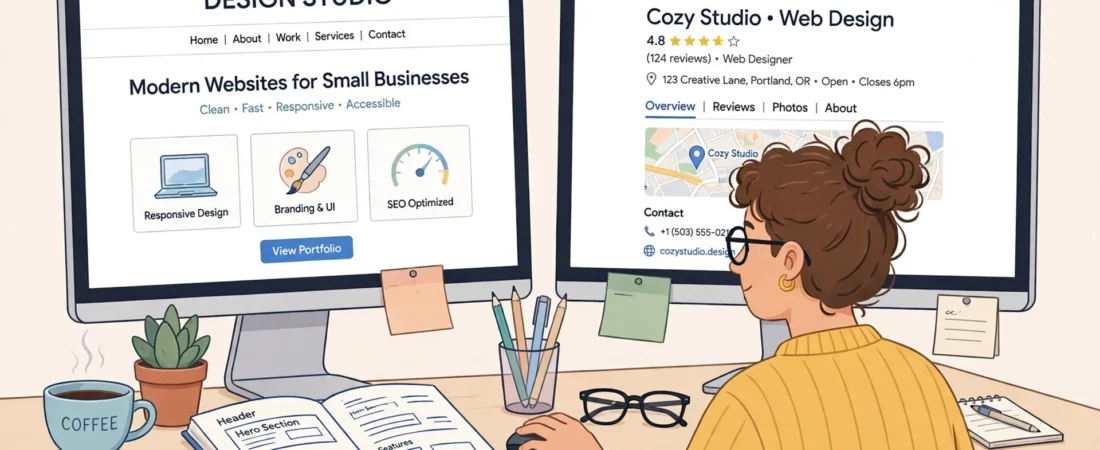
A web designer hands over a finished website, and then watches the client drift away — to a marketing freelancer, an agency, or nobody — for everything that happens next. That handover is odd, because the client already trusts the designer most, and the very next thing the client needs is not more website. It is being found. The web designers local SEO upsell is simply refusing to hand that work away: attach Google Business Profile setup, a working review system, and basic local visibility to the website project, and the same client relationship produces a bigger project and, often, a monthly retainer behind it.
This is not about designers pretending to be SEO specialists. It is about a defined, honest add-on that sits naturally on top of a site build.
The short answer
Web designers can add local SEO to a website project as a defined add-on: Google Business Profile setup or clean-up using the details already collected for the site, a working review system with link, QR code and ask routine, local basics on the site itself, and a 30-day check-in report showing the first results.
Why the add-on fits a designer’s project so well
Consider what a new website launch already involves: the client’s real business details, their services, their photos, their opening hours, their service area. That is almost exactly the raw material a Google Business Profile needs. The designer collects it anyway. Setting up the profile is the same information, entered once more, in the place customers actually look first.
There is also a timing advantage nobody else has. At launch, the client is engaged, responsive, and thinking about how customers will find them. Six months later, they are busy and the moment has passed. The designer is standing there at the one moment the add-on is easiest to sell and easiest to deliver. It helps to keep a standard add-on checklist — the same fields, in the same order, every launch — inside your project system, so delivery takes an afternoon rather than a week of improvisation.
What the add-on contains (and what it does not)
Keep it defined. A workable local add-on for a website project is:
- Profile setup or clean-up: claim or create the Google Business Profile, correct name/address/phone to match the new website exactly, right primary category, services listed, hours set, first photos uploaded.
- Review system: the Google review link and QR code created, a simple ask routine the client’s team can follow after each job, and reply templates in the client’s voice. Always within the rules — ask every customer honestly, never offer anything in exchange, never filter who gets asked.
- Local basics on the site itself: location and service pages written in customers’ words, contact details consistent everywhere, the profile linked from the site.
- A 30-day check-in: one short report after the first month — profile views, calls, reviews gained — so the client sees the add-on working.
What it does not contain: ranking guarantees, link building schemes, or ad management. If a client wants those, that is a different service or a referral. Designers considering the wider service menu will find the full picture in how freelancers can sell Google Business Profile services.
A worked example: one project, before and after
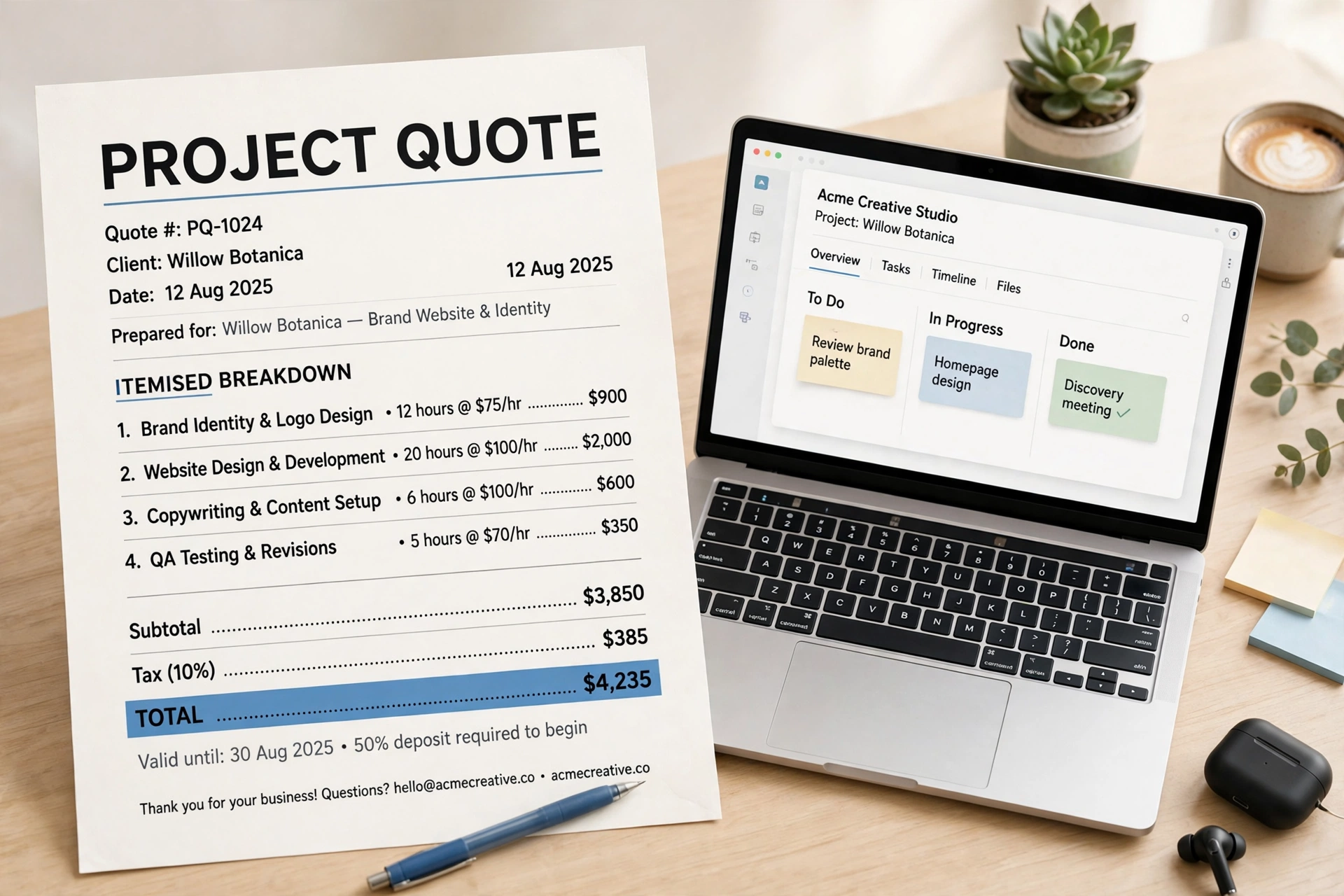
Here is an illustrative breakdown — fictional figures, labelled as an example, shaped to the ranges a solo designer might charge. A local kitchen fitter commissions a website:
| Project line | Illustrative price |
|---|---|
| Website design and build (5 pages) | £1,200 |
| Project total, website only | £1,200 |
Now the same project with the local add-on attached:
| Project line | Illustrative price |
|---|---|
| Website design and build (5 pages) | £1,200 |
| Google Business Profile setup: category, services, hours, photos | £250 |
| Review system: link, QR cards, ask routine, reply templates | £150 |
| Local pages: services + area content written for the site | £300 |
| 30-day visibility check-in and short report | £100 |
| Project total, with add-on | £2,000 |
The project has not quite doubled in price, but it has grown by two-thirds — and notice what the client received for the extra lines: not design extras, but the machinery that makes the website get found and chosen. That is an easy story for a client to understand, because every add-on line answers the question clients ask at handover anyway: “So how do people find it?”
The follow-on matters just as much. A client on a 30-day check-in is one short conversation away from a small monthly package — profile care, review replies, posts — which is where a designer’s one-off project income starts turning into recurring income. The route into that first recurring client is covered step by step in how to get your first local SEO client without ads.
Pricing it without apologising
Price the add-on as itemised lines, as in the example, not as a vague “SEO: £X” lump. Itemised lines show the client what exists; a lump invites them to haggle it down or suspect it is padding. Try one experiment first: offer the add-on on every quote for a month and track how often it is taken — most designers find the take-up surprises them, because clients were already worried about being found and simply had nobody to ask. If you need a sense of where the market sits for the profile work itself, the guide to how much to charge for Google Business Profile optimization gives the ranges. And be honest about the boundary of your expertise: the setup, review system and local basics above are well within a careful designer’s reach; anything beyond that, say so.
Delivering it without doubling your workload
The risk in any upsell is that the extra work sprawls. Keep it systemised: a fixed setup checklist for every profile, the same review-system kit adapted per client, and the check-in report in a fixed format. Designers who take this on usually find the delivery stays calm when the recurring parts — review replies, posts, monthly checks — are organised in one place built for it rather than improvised client by client. Twice the project value should not mean twice the chaos; the add-on is deliberately the most repeatable work in your business.
Questions owners ask next
How should I price the add-on?
As itemised lines, not as a vague “SEO: £X” lump. Itemised lines show the client what exists — profile setup, review system, local pages, check-in — while a lump invites them to haggle it down or suspect it is padding. Offer the add-on on every quote for a month and track the take-up; most designers find it surprises them, because clients were already worried about being found and simply had nobody to ask.
I am a designer, not an SEO specialist. Where is the honest boundary?
The setup, review system and local basics are well within a careful designer’s reach: the profile, the category and services, the review link and ask routine, consistent contact details, local pages in customers’ words. What the add-on does not contain is ranking guarantees, link-building schemes or ad management. If a client wants those, that is a different service or a referral — and saying so plainly is part of the expertise.
Will the add-on double my workload along with the project value?
It should not, if delivery is systemised: a fixed setup checklist for every profile, the same review-system kit adapted per client, and the check-in report in a fixed format. Twice the project value should not mean twice the chaos — the add-on is deliberately the most repeatable work in your business, built from details a website launch already collects.
When is the best moment to offer it?
At the website project itself, especially at handover. At launch the client is engaged, responsive, and thinking about how customers will find them — and “so how do people find it?” is the question they ask anyway. Six months later they are busy and the moment has passed. The designer is standing there at the one moment the add-on is easiest to sell and easiest to deliver.
What to do next
On your next website quote, add the local add-on as itemised optional lines — profile setup, review system, local pages, 30-day check-in — and let the client see exactly what each one is. You will not win it every time, but you will stop handing the most natural follow-on work to strangers. If you want to see how the delivery side of these add-ons can be organised as a single repeatable system, take a look at my Local Alchemist AI page.
Disclosure: the page linked above contains an affiliate link. If you buy through it, I may earn a commission at no extra cost to you.